Recertification Processes
How to begin Recertification steps on B Impact
To start your recertification process, please log into your existing B Impact account. If you have trouble accessing your account, review Sign in your existing B Impact Assessment. Please note the following instructions are for companies that have opted into the self assessment and have started the setup process which you can do so as well.
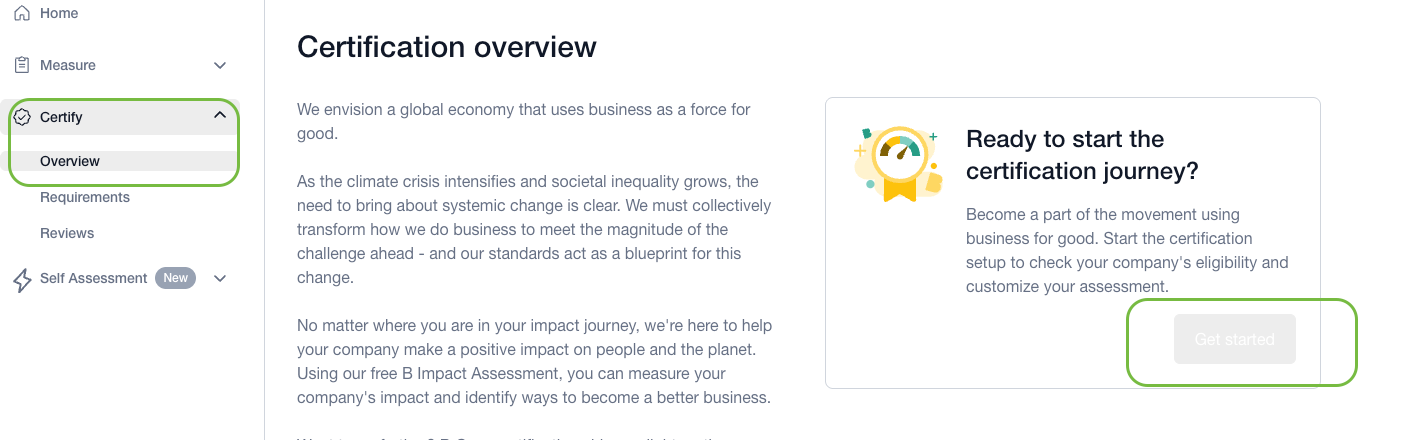
To opt into setup, navigate to the Certification section. Select Overview and on the card on the right side of the screen that reads “Ready to start the certification journey?” select Get Started.
From the Home page you'll find the Next Steps section which can give a variety of instructions. This section outlines key action items to help you begin your recertification process.
If your certification is due in more than one year, the list of next steps will be empty.
If your view indicates that you can start your recertification journey, select the “Get recertified” button.
To view your progress, navigate to the Home tab on the left-hand menu. If your company is due for recertification within the next year, a banner at the top of the page will outline the steps to get started. Please note that the Certify > Requirements tab may outline some of the requirements for certification but is currently under development and may not be the most accurate place to learn about the process.
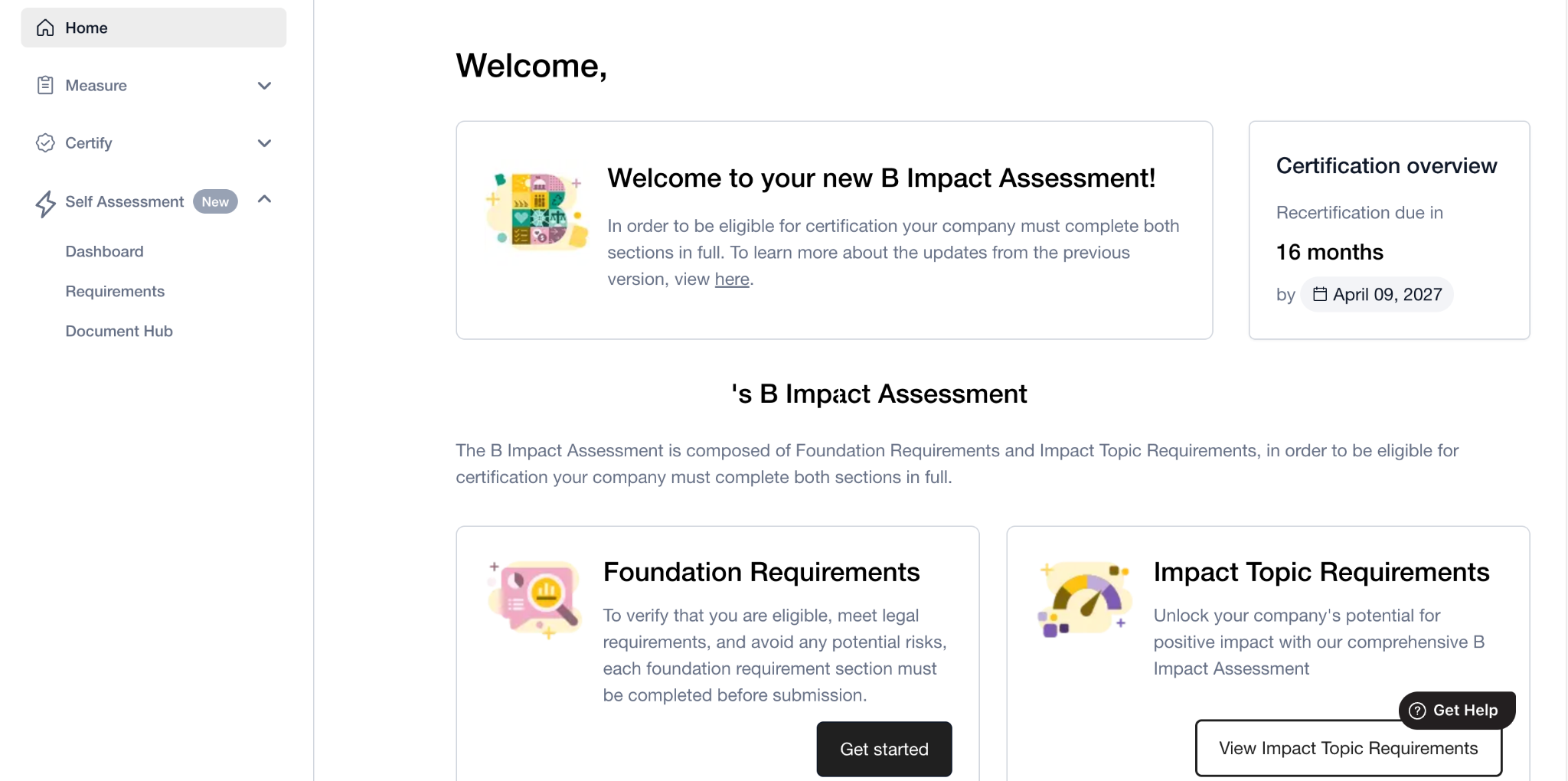
Your home page may look different if your company’s recertification date is less than a year away.
Recertification Routes for B Corps - Small, Small Medium and Medium Enterprises
Small, Small-Medium and Medium Enterprises will follow one of two routes, determined by their recertification dates.
Please note that from July 1, 2025, Route 1 is no longer applicable. All recertifying companies that have not submitted their assessment on the Version 6 standards before this date will follow Route 2 as outlined below.
For any questions or clarifications, please reach out to your Global Partner representative.
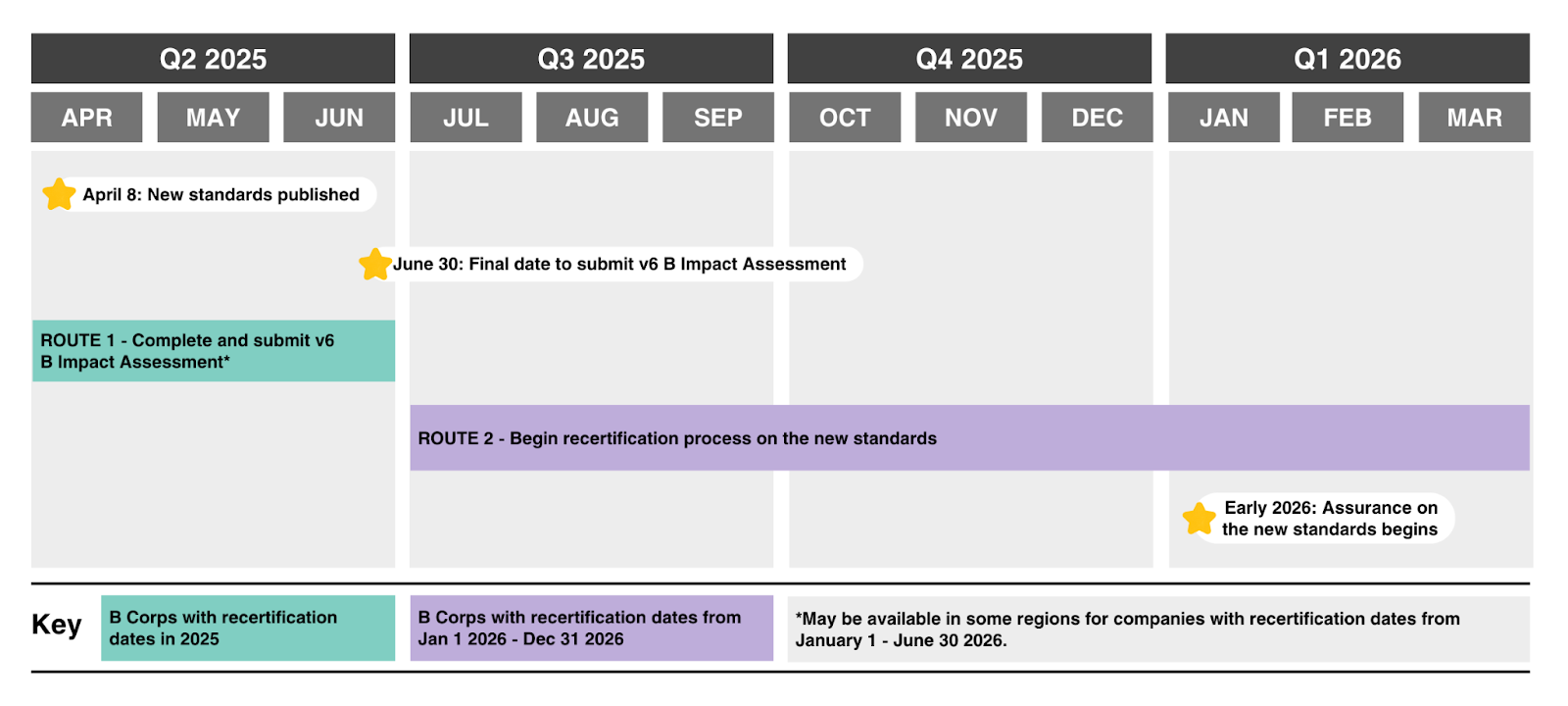
Route 1: For B Corps with a recertification date on or before December 31, 2025.
The B Corp must submit their B Impact Assessment on the current standards (Version 6) by June 30, 2025. They will complete their recertification process on Version 6, and will be required to recertify on the new standards in 2028.
This is a hard deadline - after this date, B Lab will stop accepting recertification submissions on the current standards. If the B Corp misses this deadline, they will follow Route 2.
Route 2: For B Corps with recertification dates from January 1, 2026, to December 31, 2026.*
The B Corp recertifies on the new standards, with a 12-month extension to their current recertification date. These companies should pause any further work on their current B Impact Assessment (Version 6) and focus on preparing for recertification on the new standards.
B Corps will be able to complete a self assessment in B Impact against the Year 0 sub-requirements. This process will allow companies to identify areas for improvement and consider the actions they need to take to meet the new standards.
We recommend engaging with the self-assessment as soon as possible, as it will be the first step in the new certification process. The video New standards. New tools. Same Mission provides an overview of how to do so.
Further information on the new certification process will be shared from Q3 2025.
*Route 1 may be available to companies with recertification dates from January 1, 2026 - June 30, 2026 in some regions. These companies will have received email communications from their Country and Global Partners. For further information, please consult regional representatives.
Important information for companies that operate within the European Union (EU) and engage in business-to-consumer (B2C) communications
A: B Corp certification, under the new B Lab Standards and certification model, will meet the legal requirements for being a valid sustainability label in the EU. ECGT applies to companies that engage in business-to-consumer (B2C) communications in the European Union (EU).
Starting on October 1st, 2025, you will be able to begin the process of self-identifying your company as ECGT-impacted on the B Impact platform. This is the first step to ensure you're on the right path for your recertification journey on B Lab Standards (V2.1). For detailed, step-by-step instructions on how to complete this process, please refer to our Knowledge Base article here. We may contact you based on your reported operating locations, but you are responsible for determining whether ECGT applies to your company. We recommend completing these steps by October 31.
Recertification Routes for B Corps - Large Enterprise Approach
Large and Multinational B Corps with recertification due dates in 2025 must submit their B Impact Assessment(s) on the current standards (Version 6) according to their existing submission deadlines, and no later than 3 months before their recertification cycle due date.
Large and Multinational B Corps with recertification due dates from January 1, 2026 to December 31, 2026 recertify on the new standards (Year 0 sub-requirements), with a 12-month extension to their current recertification date. Guidance in relation to how subsidiaries and related entities within a larger organization are grouped and assessed is being developed as part of the work on the new certification process. In the meantime, Large and Multinational B Corps should familiarize themselves with the new standards and begin preparing for their recertification by completing the self-assessment in B Impact.
We are ensuring that the new certification model aligns with the requirements of the ECGT. Additionally we will work with Large and Multinational Enterprises operating in, or selling into the EU, to understand how the ECGT may impact their recertification timelines. Please make sure self-identify on B Impact and follow the guidance above.
More information on the above, and related to specific recertification routes for Large and Multinational B Corps will be shared throughout the year. In the meantime, companies may reach out to their key account manager with questions or concerns as they engage with the new standards and start preparing for recertification.
What are the benefits of recertifying under the B Lab Standards V2?
For any company marketing products or services to consumers in the EU, a credible, third-party certification is no longer just a good choice—it is a legal requirement for using a sustainability label.
B Lab Standards & B Corp Certification in the context of ECGT
B Lab’s new third-party certification model under version 2 (V2) of the standards provides companies of all sizes with a streamlined way to comply with the ECGT Directive. This certification model strengthens impact credibility and meets the legal requirements for being a valid sustainability label in the EU. B Corps can safely communicate their impact and sustainability efforts through certification, thus safeguarding their reputation and credibility while reducing financial and legal risk.
Transitioning to the new standards simplifies the path to ECGT compliance.
B Lab is creating certification pathways that will enable ECGT-affected companies to be certified on the B Lab Standards V2.1 and certification model by September 2026. Your prior work on impact management has prepared you for this transition. The new standards provide a clear, streamlined path to ECGT compliance. Third-party verification under the new certification process is expected to provide companies with a reliable way to meet ECGT deadlines.
Substantiated claims and greenwashing risk reduction.
The EU directive aims to prohibit misleading practices, such as greenwashing and non-transparent sustainability labels. By transitioning, you gain a new layer of credibility and powerful resources to avoid greenwashing, ensuring your messaging is not only authentic but also substantiated, simplifying the work for you. The new B Corp Certification claims and updated brand guidelines enable companies to prove their sustainability commitments and practices. Under the B Lab Standards V2, certification meets the legal requirements for being a valid sustainability label in the EU. New brand resources include an extensive, pre-approved messaging library backed by proof points, tested with consumers, reviewed by B Lab experts, and rooted in our standards. Many of these new claims can only be used by companies verified on V2.
Credible, third-party-verified certification. B Lab’s new certification model will comply with the ECGT Directive, effective September 2026. This means that by certifying under V2, you can publicly communicate your certification in the EU. The B Corp logo signals that you uphold social, environmental, and governance standards laid out by B Lab and verified by an independent third party meeting B Lab certification requirements for assurance providers based on ISO 17021-1. For this reason, V2 of the standards represents a clear step towards credibility.
A step to avoid fines and brand damage. The B Lab Standards V2, and our approved B Corp claims and brand guidelines, comply with ECGT. By transitioning to the new standards, you are reducing your company’s financial risk and the significant brand damage that comes from non-compliance. Failure to transition and communicate your status under the new standards could expose your company to legal and financial risk. While this is a worst-case scenario, the fines for non-compliance under the ECGT directive can be up to 4% of a company’s annual turnover. One way to mitigate this risk is to begin your transition to the new V2 standards now.
B Lab Standards & EU Empowering Consumers for the Green Transition (ECGT) Directive
TABLE OF CONTENTS
- What is ECGT and who’s impacted?
- What does this mean for your B Corp Certification?
- What is the first step?
- You’ve self-identified as ECGT-impacted. What next?
- What if I did not submit on V2 by July 15, 2026?
- What if I don’t take any action by September 27, 2026?
What is ECGT and who’s impacted?
The Empowering Consumers for the Green Transition Directive (ECGT - Directive 825/2024/EU) seeks to enable consumers in the European Union (EU) to make informed purchasing decisions that contribute to more sustainable consumption practices – a goal that B Lab shares. EU Member States must transpose the directive into national law by March 27, 2026, with the new rules becoming applicable on September 27, 2026.
For B Corps, this matters because ECGT changes the legal context for how sustainability labels and claims can be used in the EU. As a certifying organization operating in the EU, B Lab has been actively preparing for ECGT for years, building awareness and relationships in Brussels. Our policy team has engaged with legislators, certification peers, legal, and assurance specialists to understand how this directive impacts us and develop our approach to meeting its requirements.
In 2025, we officially communicated to B Corps that under B Lab’s new certification model and B Lab Standards V2, B Corp Certification meets the legal requirements for a valid sustainability label in the EU. Our new third-party verification system uses ISO 17021-1 accredited assurance providers. In January 2026, we launched new logo use and claims guidelines for B Corps. That means companies certified under the new standards and third-party assurance model will be able to communicate their B Corp status with confidence.
We are closely following the ongoing development of the transposition of ECGT into national laws by EU Member States. We empathize with the challenges B Corps face in responding to legislation that is still evolving. We will keep the community informed of any changes in our position or approach.
What does this mean for your B Corp Certification?
ECGT applies to companies that engage in business-to-consumer (B2C) communications in the European Union (EU). Like data privacy or other consumer protection laws, companies can be impacted regardless of their own geographic locations.
If your company is one of those impacted by ECGT, early action is important. B Lab's recommendation for these companies is to recertify on the new standards (V2). Companies that intend to recertify before the ECGT rules start applying should begin working in B Impact and submit their self-assessment as soon as possible.
While recertification may not be finalized before the ECGT rules start to apply on September 27, 2026, submitting on V2 is the clearest way to demonstrate that your company is actively working toward compliance and to reduce your legal and reputational risk in the meantime.
→ Find out more about the benefits of recertifying with V2 standards.
What is the first step?
The first step is to self-identify in B Impact, telling us whether or not your company is impacted by ECGT.
Self-identification helps B Lab understand which companies are affected by ECGT so we can provide the right communications and support.
How to self-identify:
Log in to B Impact: Go to your company account in B Impact and sign in.
Open your account settings: In the top-right corner of the screen, click on your profile initials.
Select “Manage account”: From the dropdown menu, click Manage account.
Go to the Company section: In the left-side menu, select Company.
Find the “Regulatory Information” section: Scroll until you see Regulatory Information.
Locate the ECGT field: Find the section labeled ‘EU Empowering Consumers for the Green Transition (ECGT)’.
Click “Add”: Click Add to complete the self-identification step.
Confirm whether your company is impacted: Indicate whether your company is impacted by ECGT.
Once completed, your response will be saved in B Impact.

You’ve self-identified as ECGT-impacted. What next?
After you self-identify as ECGT-impacted, B Lab will contact you via email to confirm your self-identification and outline next steps.
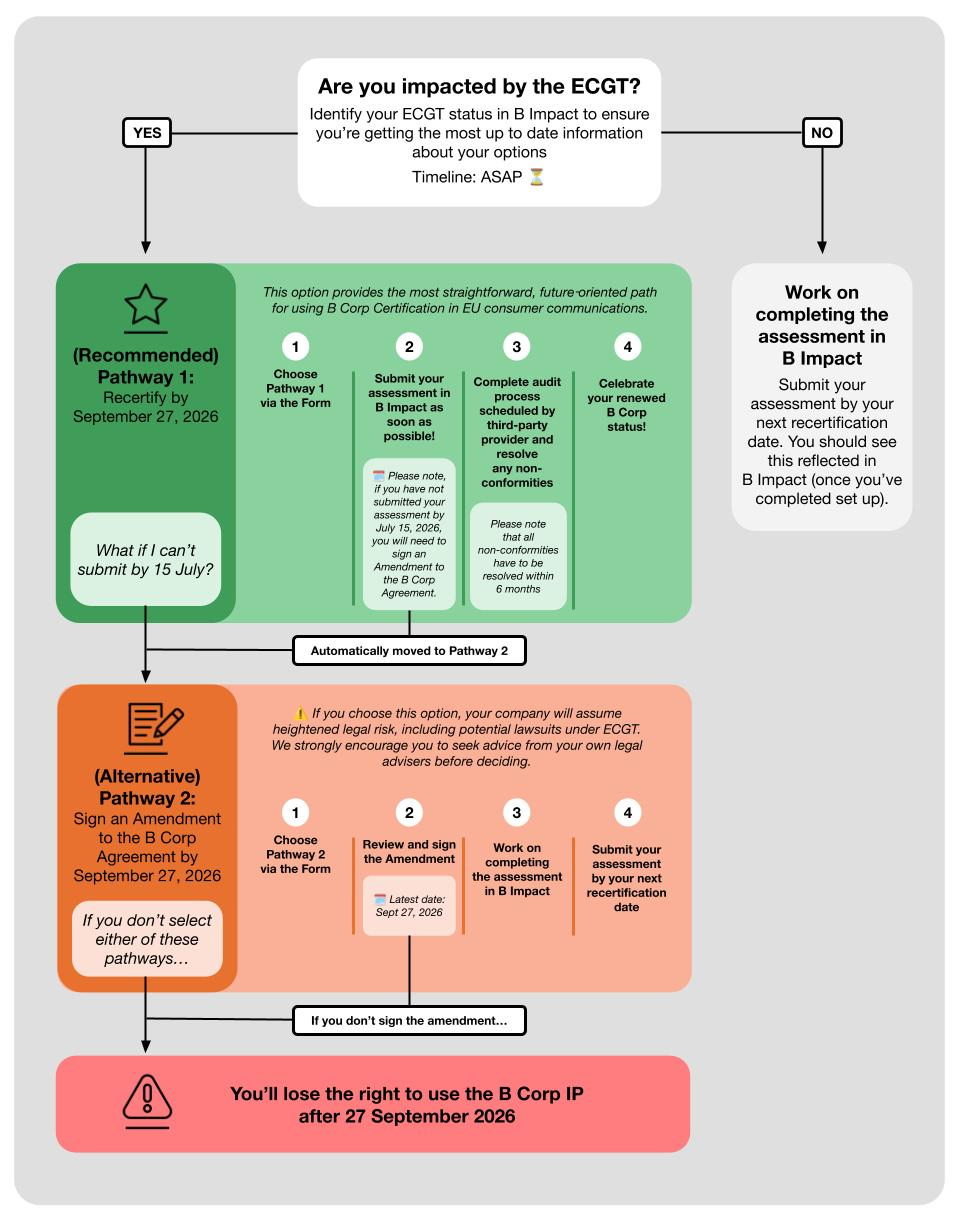
If your company has self-identified after July 15, 2026 → Go to this section.
Start your recertification process and complete the Self-Assessment, available now in B Impact.
Submit for recertification as soon as possible
If your company submitted its self-assessment by July 15, 2026:
Your company can continue using the B Corp logo and making certification‑related claims while your recertification is being completed, even if the audit process is not fully finalized by September 27, 2026.
B Lab does not guarantee that recertification will be completed by September 27, 2026, as timelines depend on auditor availability, your company’s readiness, and the outcome of the verification process.
Adopt new logo use and claims guidelines, in compliance with the new brand book, by August 31, 2026.
What if I did not submit on V2 by July 15, 2026?
After July 15, 2026, ECGT‑impacted companies that have not submitted their self-assessment are expected to sign the 2026 Amendment to the B Corp Agreement to continue using B Corp intellectual property while they work toward recertification on V2.
Companies that choose this alternative will:
Remain a certified B Corp on V1.6.
Commit to complete recertification on V2 by your next scheduled recertification date as reflected in B Impact.
Adopt new logo use and claims guidelines by August 31, 2026.
Sign an amendment to your current B Corp agreement by September 27, 2026, including:
A liability waiver, agreeing not to take legal action against B Lab in the event of any ECGT-related challenges resulting from your choice to continue using the B Corp logo and claims before recertifying on V2.
Agreement to the terms of the updated third-party verification process.
An acknowledgment that V2 and the updated certification process are an evolution of the current B Corp certification.
Assume heightened legal risk, including potential lawsuits under ECGT.
Even if your company is ECGT-impacted and has not submitted on V2 by July 15, 2026, and needs to sign the Amendment, B Lab’s strong recommendation remains the same: prepare your B Impact self‑assessment on the new B Lab Standards (V2) and submit as soon as possible.
What if I don’t take any action by September 27, 2026?
ECGT-impacted B Corps that do not submit their self-assessment on the V2 Standards by July 15, 2026, nor sign the 2026 Amendment to the B Corp agreement by September 27, 2026, will lose the right to use the B Corp logo or refer to themselves as Certified B Corporations.
Companies must remove all use of the B Corp logo, trademarks, and certification claims across all current materials and channels (including packaging, marketing materials, digital platforms) by September 27, 2026.
These companies may not engage in any public communication about their certification.
B Lab will not confirm their certification if asked by journalists or other members of the public.
Companies may participate in community events, but they cannot imply or claim certification (e.g., participating in B Corp panels, B Corp Month campaigns, etc.).
B Lab will not refund certification fees since only companies that fail to respond to the other options will be in this situation.
If the company later completes recertification under V2 and signs the new B Corp agreement, they will be able to adopt the new logo guidance and claims and once more refer to themselves as a Certified B Corporation.
While strict, this measure is not intended to be punitive.
As a global, interdependent movement, we must protect trust in our certification and the reputation of B Corps that do comply.
B Lab may take legal action to protect our community and trust in our brand.
Guidance for all B Corps due to recertify in 2025 and 2026
Background and Context
In December 2020, B Lab announced a review of the performance requirements for B Corp Certification in response to community and stakeholder feedback about evolving leadership in social and environmental performance. Following input from over 1000 stakeholders, the new standards address today’s most urgent social and environmental challenges, providing clear and impactful requirements for companies to demonstrate leadership and drive systemic change.
We want to give the B Corp community the opportunity to begin working towards the new standards as soon as possible. Given the diversity within our community, B Corps will follow different routes to recertify on the new standards based on their recertification date, size and complexity. B Lab is committed to supporting B Corps in their efforts to meet the new standards in a structured way.
At the heart of B Corp Certification is continuous improvement. We’re not striving for perfection, but progress. The sub-requirements of the new standards are structured in phases, guiding companies on a journey of continuous improvement over a number of years.
To achieve initial certification, companies must meet a set of sub-requirements, progressing to meet additional sub-requirements in Year 3 and Year 5. To maintain their B Corp certification, companies must continually meet all applicable sub-requirements from the time they become effective. Learn more here.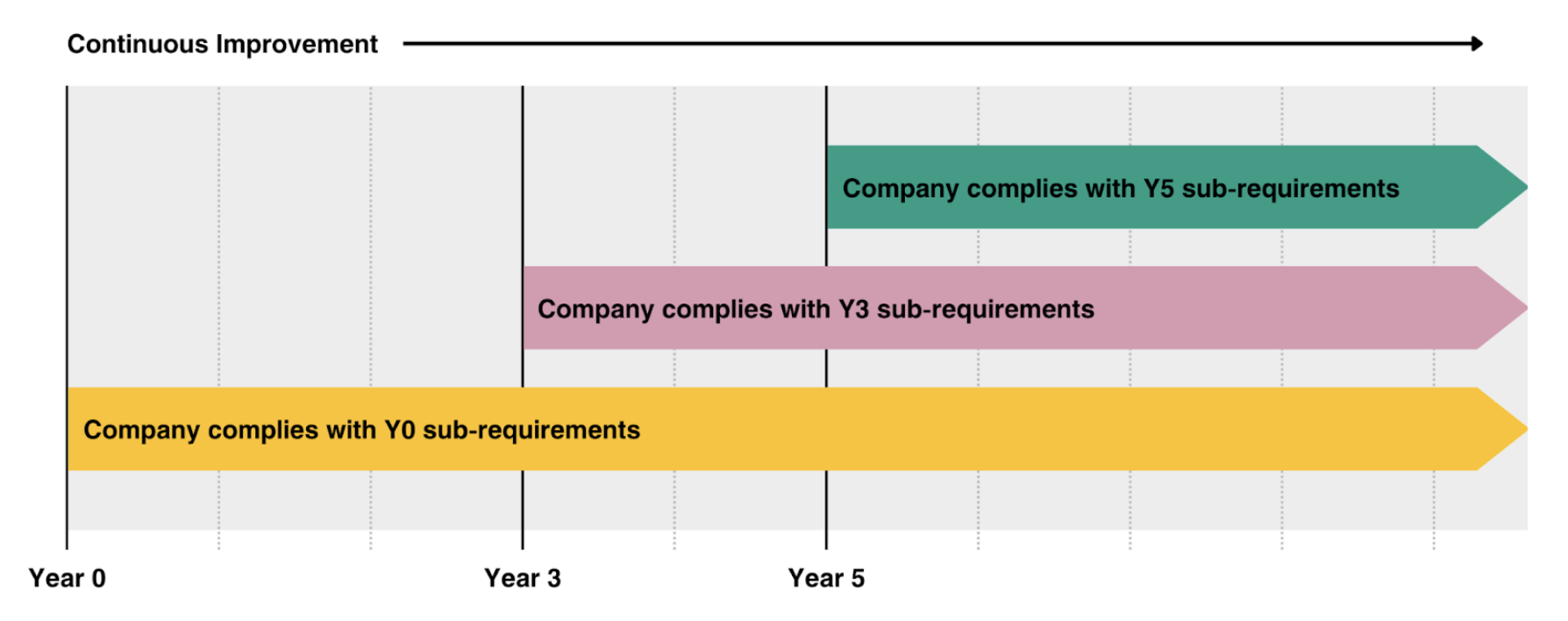
Scope and Applicability
This policy applies to the following groups of B Corps:
Small, Small-Medium, and Medium Enterprises:
With recertification due dates in 2025/2026
Large Enterprises and Multinational Companies:
With recertification due dates in 2025/2026
Please note that companies certifying for the first time are not covered by this policy. For further information for requirements relating to this group, please see the Frequently Asked Questions.
All companies with recertification dates in 2026 have been granted a 12 month extension to their recertification date. B Corps can find their extended recertification date by logging in to B Impact.
Companies with recertification dates in 2027 should expect to recertify on the new standards on their current recertification date. More information on the certification journey will be provided from Q3 2025.
This policy will take effect from April 8, 2025. Subsequent updates will be communicated to companies with recertification dates beyond December 31, 2026.
Resources and Related Documents
For further information and resources, please refer to the following:
Glossary
B Corp: A company that has been verified under the current standards (Version 6) of the B Impact Assessment and scored 80 or above.
Certification: Certification is an independent audit of a company’s compliance with a set of standards.
Extension: An extension is an additional amount of time past a B Corp’s established recertification date, granted to enable the company to appropriately prepare itself for recertification on the new standards. B Corps will be expected to submit their assessment on the new standards for verification by their extended recertification date.
Large Enterprise Approach: one of B Lab’s certification approaches designed for companies that generate more than $100MM USD in annual revenue with 10 or more subsidiaries operating in multiple countries or generate more than $1B in annual revenue. For more information on current certification approaches, see this article.
New Standards: This refers to B Lab’s new standards, published on April 8, 2025. The new standards consist of Foundation Requirements and seven Impact Topics. You can learn more about the new standards here.
Small, Small-Medium and Medium Enterprises: Within B Lab’s certification approaches, Small and Medium Enterprises are companies that generate an annual revenue less than $100MM USD, or generate more than $100M USD in annual revenue with typically fewer than 10 subsidiaries or that operate in a single market. For more information on current certification approaches, see this article.
Sub-Requirements: This refers to the specific requirements that a company must fulfill to achieve certification. The sub-requirements will depend on a company’s size, sector, industry and geographical location. Learn more here.
Recertification Date (Small, Small-Medium and Medium Enterprises only): The date by which B Corps are expected to complete the verification on Version 6 of the standards and B Impact Assessment, in order to maintain their B Corp Certification. If following Route 2, this is the date by which B Corps must submit their updated self-assessment for review.
Recertification Route: The steps that companies must take in order to go from being certified on Version 6 of the standards to recertifying on the new standards.
Version 6: The version of the Standards for B Corp Certification updated in January 2019, spanning five impact areas. These standards are found in the B Impact Assessment and have been used for certification. They will be superseded by the new standards from April 2025.
Guidance for all B Corps due to recertify in 2026 and 2027
Recertification Routes for B Corps
Purpose
From February 2026, existing B Corps have been able to certify against the Y0 requirements of the V2 standards.
This guidance outlines the required recertification routes for B Corps with recertification due dates in 2026 and 2027. Guidance for companies with recertification due dates after 2027 will be provided in due course.
Aspiring B Corps certifying for the first time are not covered by this policy. Please refer to the Frequently Asked Questions for information relevant to this group.
Recertification Routes for B Corps
We encourage all B Corps to submit their completed self-assessment as soon as possible to secure a place in the audit queue. The latest date a B Corp may submit their self-assessment for audit is their current recertification due date.
Special provisions apply to B Corps affected by the Empowering Consumers for the Green Transition (ECGT - Directive 825/2024/EU) Directive, which applies to companies that engage in business-to-consumer (B2C) communications in the European Union (EU). If you think your company is in the scope, please let us know. Find more information here.
Additional Information
Brand Requirements
All B Corps, regardless of recertification dates, must update all digital and newly printed materials to comply with the new Brand book.
Transition Period
As we are in a transition period with new standards and audit processes, B Lab may refine submission guidance as we learn more about process timelines. Updates will be published if policies change.
Approximate Audit Timelines
As companies progress through the audit process, we are gaining further insight into typical timelines. Approximate audit timelines are outlined below and are intended to support planning and decision-making.
Audit scheduling: The audit will be scheduled within 50 days of clicking “submit” in B Impact.
Audit duration: Audits typically require 1–10 days, depending on company size (companies operating multiple sites may require additional time for site sampling)
Certification decisions: An audit report is shared at the end of the audit process. This details the results of the audit, whether any non-conformities were found, and the overall certification decision. A positive certification decision can still be made if the company has only minor non-conformities. If major non-conformities are identified which prevent a positive certification decision, the company will be afforded 6 months to close major non-conformities, resulting in a final certification decision for the initial audit.
Subsequent Audits
Certification is valid for five years, however, companies must undergo subsequent audits to maintain their certification.
Following a positive certification decision after the initial audit, the Assurance Provider (AP) will schedule subsequent audits 12, 24 or 36 months from the “certification valid from [x]” date listed on the certificate (see AP Certification Requirements 9.6.1.1).
For more information on pre-audit actions that a company has to complete before a subsequent audit, see Table 7 (p. 40) in the document Certification Process Requirements for B Corps.