Revenue record keeping for certification
What should I do if I have a unique revenue model when completing the self assessment?
For companies with unique revenue models to calculate their revenue for B Corp certification, there may be specific guidance here that is relevant to your company. This revenue informs a company’s track as well as certification fees.
Revenue Last Year Guidance
Generally, the company should provide their “gross revenue” figure and a copy of their income statement.
If “gross revenue” is not commonly used in their industry, the company can calculate their revenue as “net sales,” i.e. “gross sales / fees less returns and discounts.” See below guidance for net sales calculation by industry.
Companies can report their revenue and income on either an accrual basis or cash basis, so long as the method used is in-line with historical financial statements.
As a general principle, companies should include all positive, regularly recurring revenue / other income line items.
* In some international English-speaking markets, Gross Sales is referred to as “Turnover”. In Spanish, Gross Sales translates to “Ventas Brutas” and in Portuguese it is “Vendas Brutas”.
*** Pass-through revenue examples include donation revenues which are then sent directly to a foundation, travel booking companies with flight-cost pass-through expenses, marketing companies with ad buys, and gift card companies with pass-through revenues directly to stores.
What are examples of unique revenue models?
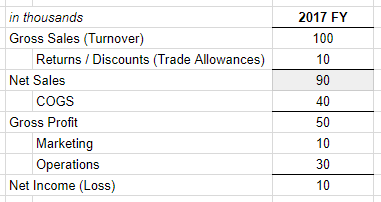
Retail - account annual revenue for 2017 is $90K
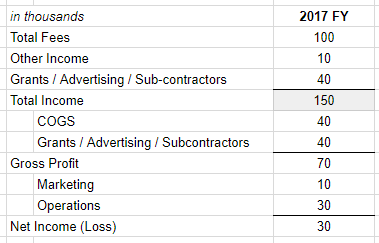
Marketing / Consulting or General Contracting - account annual revenue for 2017 is $150K
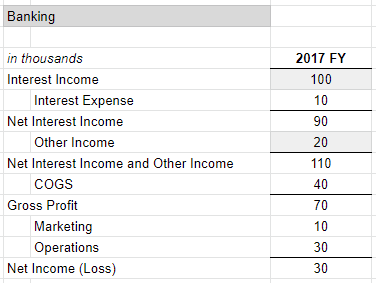
Banking - account annual revenue for 2017 is $120K
Should revenues from grants/subsidies be included in ‘Revenue Last Year’ figure in B Impact?
Companies should exclude “contributed revenue” such as grants / subsidies and donations from their `Revenue Last Year’ calculation.
Should revenues/income via capital gains, investment income or other income be included in their ‘Revenue Last Year’ figure in B Impact?
The investment revenue/income should be included in the ‘Revenue Last Year’ figure if all of the following criteria are met.
The revenue/income is captured in the company’s taxable income (this can be verified by sharing a screenshot of the income line item in a company’s most recent tax filing)
The realized income revenue/income has been present in the tax filing in two of the last three years of profit and loss statements (e.g. a real estate company earning income from selling apartment buildings)
If investment income is included, it can be offset by investment losses.
How should investment funds / asset management companies calculate fees?
Revenues for investment funds / asset managers would be calculated as the total Gross Revenues on their income statement. As with all companies, any pass-through revenues that flow through the income statement would be included. Typically asset managers earn their revenues from management fees and carry (both would be included in the calculation). However, if the company listed an interest expense line item similar to a bank, the company should follow the banking guideline and not net out the interest expense from the revenue.
Should income from exchange rate differences be included in the total revenue?
Yes. Since it is included in a total revenue line item, it should be included.
When calculating the percentage of profits donated, should the company use net profit or gross profit?
Net profit.
Should intercompany revenues (holding charges in Europe) be included in the company’s total revenue?
The company should ensure that the revenues from the customer are only counted once. If a multi-assessment company has one subsidiary that pays the parent a holding charge, the company can exclude holding charges from the parent so long as the full customer revenues from the external customers / clients is captured for in-scope entities. I.e. the company should not subtract holding charges from both the parent and the subsidiary revenues.
Should sales taxes and value-added taxes (VAT) be included in company revenues?
Per the articles linked here and linked here (and in the IRIS Total Revenue Definition) in the US, sales taxes are accounted for on the balance sheet and not the profit and loss statement where Annual Revenues are determined. Given this, for congruity across regions it is recommended that sales taxes and value added taxes are not included in a company’s Account Annual Revenue.
Note: in most cases the sales tax and VAT will not be listed on a company’s profit and loss statement so no further action is needed
However, as an example, if a company’s profit and loss statement lists a revenue of $55M and this is broken into Net Sales of $50M from products and $5M of sales tax/VAT, the Revenue Last year in our assessment should be just the $50M.