Foundation Requirements and Scoping
How to find and work on your Foundation Requirements
- Introduction
- Foundation Requirement in B Impact
- Navigating to the Foundation Requirements
- How to complete the Foundation Requirements
Introduction
This article explains how to complete the Foundation Requirements in B Impact, which are the starting point for B Corp Certification. It covers the three areas you’ll need to complete—Eligibility, Legal Requirements, and, where applicable, the Risk Profile—and explains what to expect in each section before moving on to the self-assessment.
Foundation Requirement in B Impact
The Foundation Requirements establish the key eligibility and accountability requirements for B Corp Certification. All companies must meet them, regardless of size, sector, or location.
In this section of B Impact, you will assess your eligibility, meet the B Corp Legal Requirement, and complete a Risk profile. While Eligibility and Risk must be completed before you submit your assessment, the timeline for meeting the legal requirement will depend on your company's size, legal structure, and jurisdiction.
It is critical to make sure all the Foundation Requirements section is completed before working on the self-assessment to ensure that your company is eligible for certification. Additionally, your responses in the risk profile may add additional requirements to your self-assessment.
Navigating to the Foundation Requirements
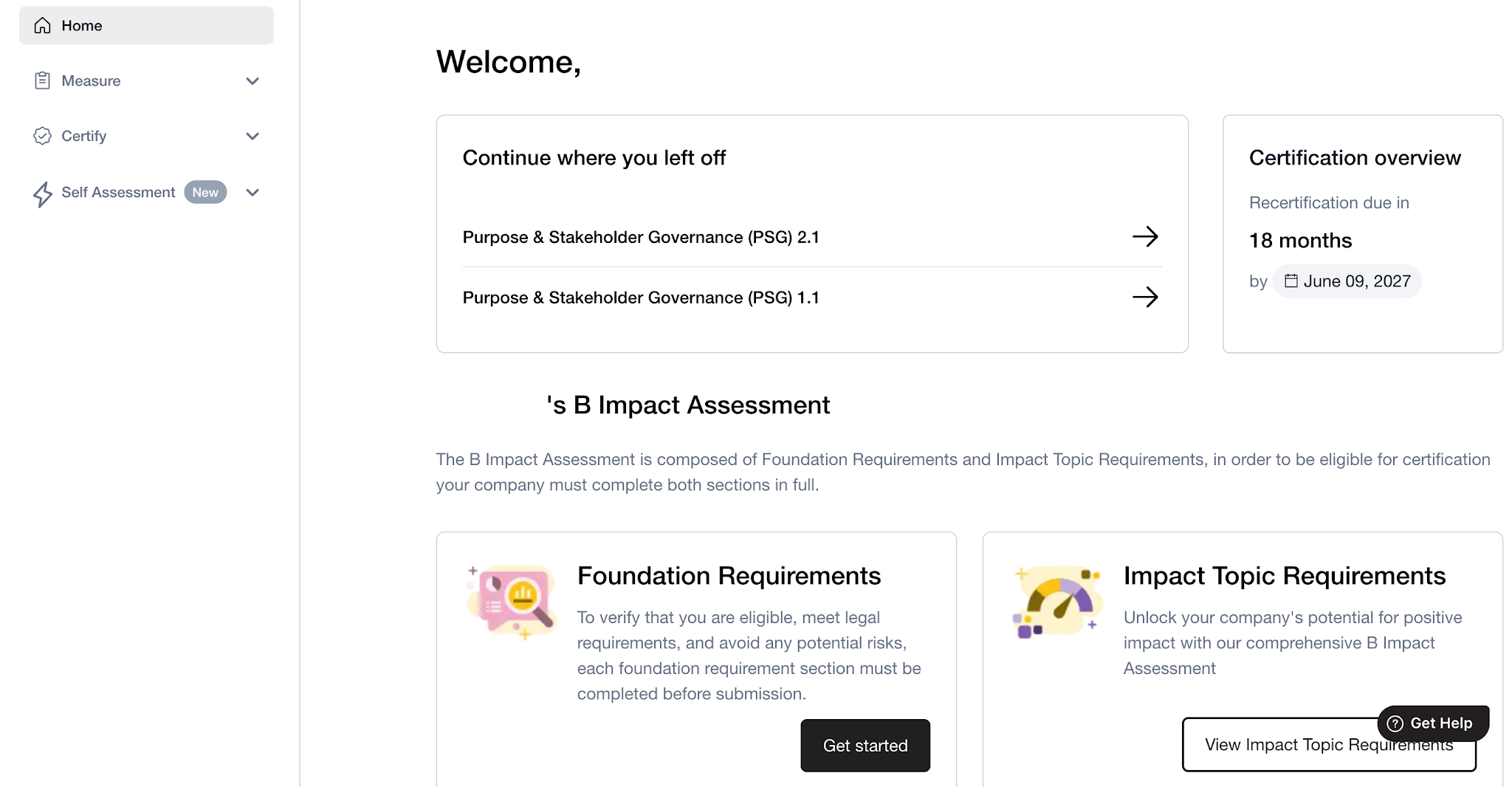
To navigate to the Foundation Requirements, select Assessment from the left-hand menu and select Foundation Requirements from the drop-down menu. You can also access the Foundation Requirements from your Home page.
Based on your company’s size, you will see two or three cards in this section:
FR1 – Eligibility: Ineligible industries and practices
FR2 – Legal Requirement
FR3 – Risk Profile (not applicable to Companies without workers or Micro companies)
How to complete the Foundation Requirements
1.Eligibility: Controversial Industries and Practices
The Eligibility section confirms that your company does not operate in industries or engage in practices that pose a high risk of negative impact to stakeholders. You’ll complete a short questionnaire to assess whether your company is significantly involved in industries or practices that undermine B Lab's Theory of Change.
For more details, see FR1.2: Determining eligibility for companies in restricted industries
2. Legal Requirements
The Legal Requirement section will indicate what actions your company has to take to meet the legal requirement. The timeline for meeting the legal requirement depends on your company's size, legal structure, and jurisdiction. Meeting the legal requirement may look different for different types of companies – whether it be adding language to your company’s governing documents or formally registering with a benefit corporation structure. Use our legal tool to understand your company’s pathway to meeting the legal requirement. Your company’s pathway and timeline for meeting the legal requirement will be indicated in this section on B Impact as well.
To upload evidence for the legal requirement, you’ll first need to add each entity that is in scope of your certification. Input the legal structure of each entity (for example, LLC, BV etc.). Once your entities are added, you will be able to see the legal pathway and upload evidence for each entity in scope. Note that you can only upload one document per entity – if you uploaded the incorrect file, you’ll have to delete it and upload a new document.
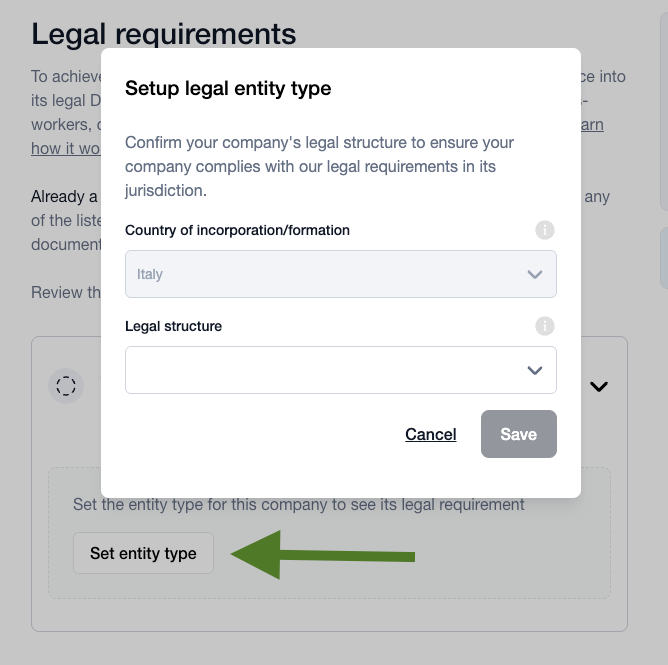
Evidence submitted will be verified by B Lab. This section will be completed when the status indicates either No immediate Action or Validated.
For more details on meeting the legal requirement, see FR2: How to meet the legal requirement.
3. Risk profile
Only companies designated “Small” and above have to complete the Risk profile. The Risk profile is a questionnaire with 14 questions that helps identify whether your company's activities present elevated human rights or environmental risks. The Risk profile helps companies assess their potential negative impacts and support them in identifying, preventing, and mitigating them. Based on your responses, specific sub-requirements may be added to the self-assessment.
Note that answering "yes" to a Risk Profile question does not make your company ineligible for certification – it simply ensures that companies with higher-risk activities are expected to demonstrate additional due diligence.
If you’re unsure about an answer, read through the guidance and definitions. Answer the question using the precautionary principle to risk. If you remain unsure, then answer “yes”.
As part of our transparency requirements, any affirmative responses to questions in the Risk Profile will be reflected in your public profile in the B Corp directory after certification.
For more details, see Managing negative impact through the Foundation Requirement.
You are able to edit your responses in the Risk Profile easily at any time before submitting your self-assessment for audit.
Integration of the Baseline Requirements into the new B Lab Standards
To achieve B Corp Certification under Version 1.6 (“V6”) of the B Impact Assessment, companies with annual revenue of US$5 billion or more must meet minimum baseline requirements alongside the core certification requirements. These include adopting stakeholder governance, achieving an overall verified score over 80 on the B Impact Assessment, and successfully completing the Disclosure Review process for controversial issues.
These additional requirements reflect the greater scale, influence, and responsibility of these companies, ensuring that Certified B Corps of this size demonstrate strong, verified performance on key social and environmental issues in addition to achieving a score of 80 or above on the B Impact Assessment.
In November 2023, the Multinational Standards Advisory Council (MNC SAC) approved the integration of the Baseline Requirements into the new B Lab Standards. Aligned with B Lab’s new company size categories, these requirements primarily apply to XX Large and X Large companies, but may also apply to smaller companies, with compliance criteria scaled based on company size and impact to reflect business relevance.
The sub-requirements apply to both parent companies and independently certifying subsidiaries, with adjustments made accordingly. As a result, all sub-requirements for US$5billion+ Certified B Corps pursuing recertification are now incorporated under the new B Lab Standards.
Given their complexity, some of the Baseline Requirements have been broken down and separated into several sub-requirements across the various impact topics. To accommodate varying governance structures, the term "Board of Directors" has been replaced with "highest governing body within the scope of certification." This ensures that oversight responsibilities rest with the most relevant governing body—whether at the subsidiary or parent level—recognizing that subsidiaries often follow group-wide policies that may not be directly overseen by the parent board.
Certified B Corps that have had their Baseline Requirements approved are likely to already fulfill many of these new integrated sub-requirements. However, additional compliance criteria may apply. These companies are strongly encouraged to conduct a gap analysis to identify any areas requiring further action to align fully with the new Standards.
This guidance outlines for each Baseline Requirement:
a) The corresponding sub-requirement under the new B Lab Standards
b) Any changes to compliance criteria
c) Adaptations for smaller companies where applicable
The existing Guidelines for Acceptance remain largely applicable and have been integrated into the new B Lab Standards, however, most corresponding sub-requirements now include expanded compliance criteria.
The most significant change to the original Baseline Requirements involve aspirational goal setting and the grievance procedure.
Governance oversight previously assigned to a Board of Directors is now designated to the highest governing body within the scope of certification, recognizing the diversity of governance structures across B Corps. Additional requirements under PSG5 require highest governing bodies to oversee social and environmental impacts as well as stakeholder considerations, ensuring that these are integrated into the company’s strategy and operations.
A company’s highest governing body within the scope of certification will be identified during the pre-verification process. For instance, the highest governing body of a parent company would be different to that of a subsidiary pursuing independent certification. Reliance on the parent company’s Board is no longer sufficient. This shift ensures accountability for implementation and meaningful application of group policies at the certifying level.
Impact reporting must now be overseen by the highest governing body to ensure top-level accountability for transparency and performance.
The grievance procedure has been separated from the materiality assessment and is now treated as a stand-alone requirement (PSG3), with an emphasis on oversight, transparency, and accountability. This recognizes that many existing grievance mechanisms are not used effectively, and therefore companies are required to disclose sufficient information to ensure the adequacy of the company response as well as implementing management and company learnings.
Aspirational goals have been removed and replaced with PSG2.4, which asks companies to set targets and report annual progress on material topics not addressed in the B Lab Standard through a gap analysis. This is because formerly acceptable aspirational goals, such as setting science-based targets and living wage goals, now sit in their own sub-requirements. The new Standards set a high bar for larger companies, and PSG2.4 ensures that the company’s B Impact Assessment provides a holistic overview of a company’s impact.
Lobbying disclosures have been strengthened to include mandatory reporting on political contributions.
Country-by-country tax reporting is now required as part of the broader tax disclosure, and both parent companies and subsidiaries must meet this requirement.
Companies are no longer able to meet the human rights policy requirement by either committing to the key human rights covenants or by identifying their salient human rights issues; a formal human rights policy is now required with specific compliance criteria.
What happens to the risk standards under version 6 of the standards?
They only apply to version 1.6 and not the new standards.
The Risk Tool is being integrated into B Impact as an automated, interactive feature. In the meantime, to give companies more time to prepare, we created FR3.1.a to FR3.1n to temporarily share the 14 questions and resulting actions from answering “yes”. This is a temporary layout using the existing sub-requirement structure, which is why the content looks different.
What company type is required to complete FR3?
FR3.1 applies to all company sizes, except those without workers and micro companies.
If your company is considered micro or a company without workers, then you are exempt from FR3.1. These smallest companies are exempt, recognizing their inherently lower risk profiles. Read this article for more information about company size.