SDG Action Manager
What is the SDG Action Manager?
The SDG Action Manager was developed by B Lab and the UN Global Compact to help your company take action on the Sustainable Development Goals.
Sign in to your B Impact portal and you will land on the home page.
Navigate to the Measure tab, and select “SDG Action Manager” from the drop-down menu.
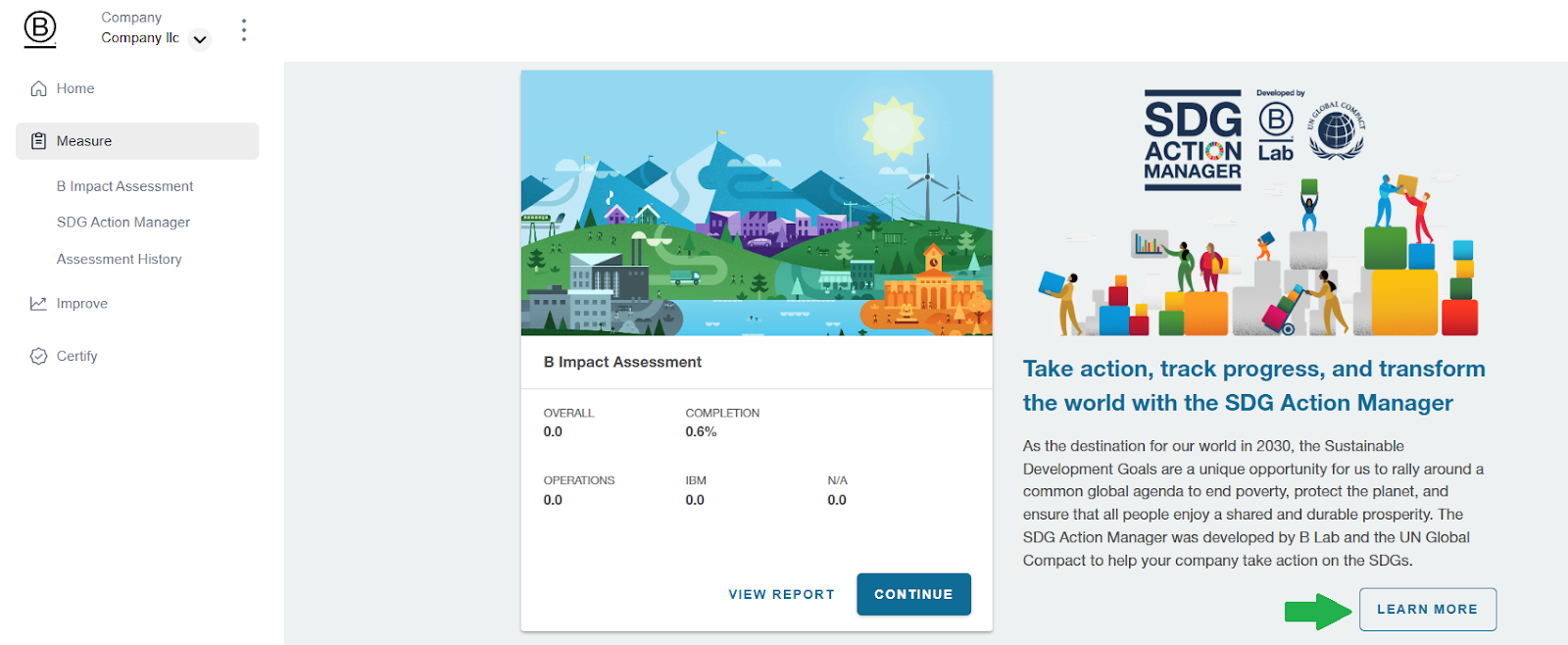
On this page, select "Get Started" to navigate to the SDG Action Manager.
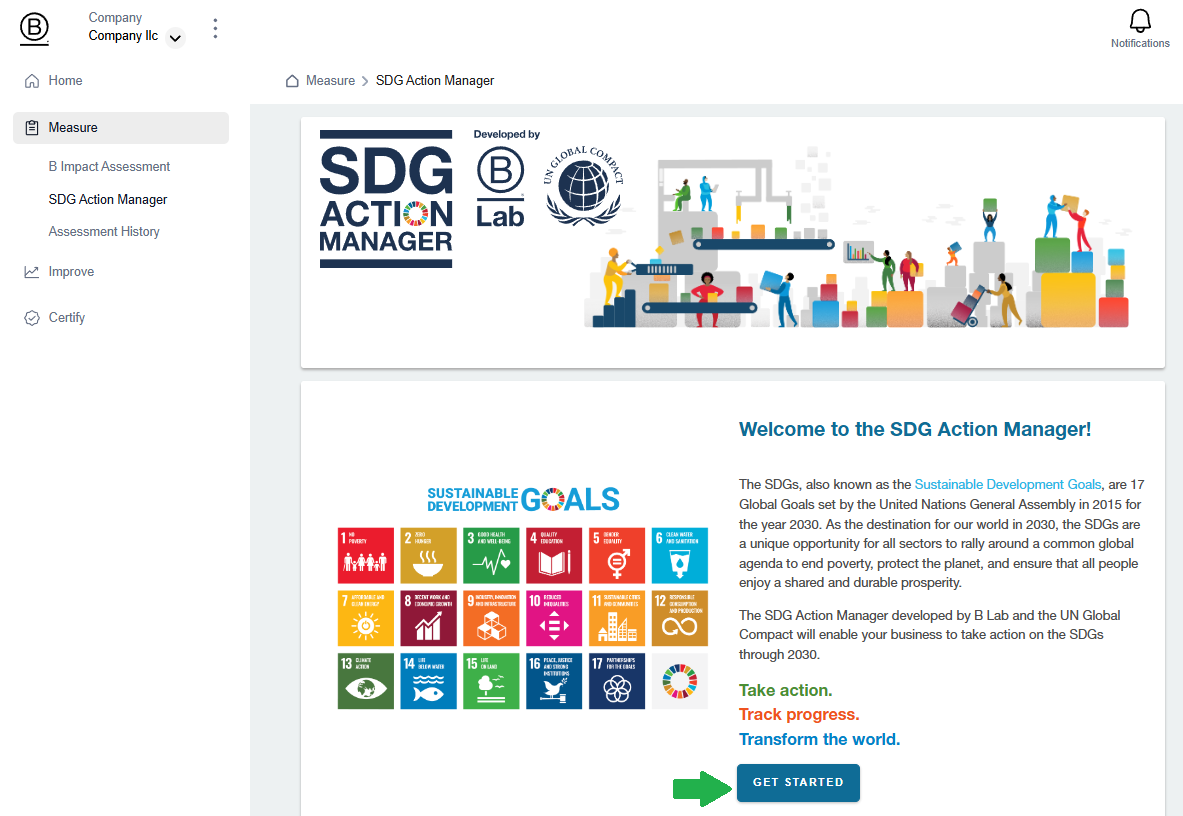
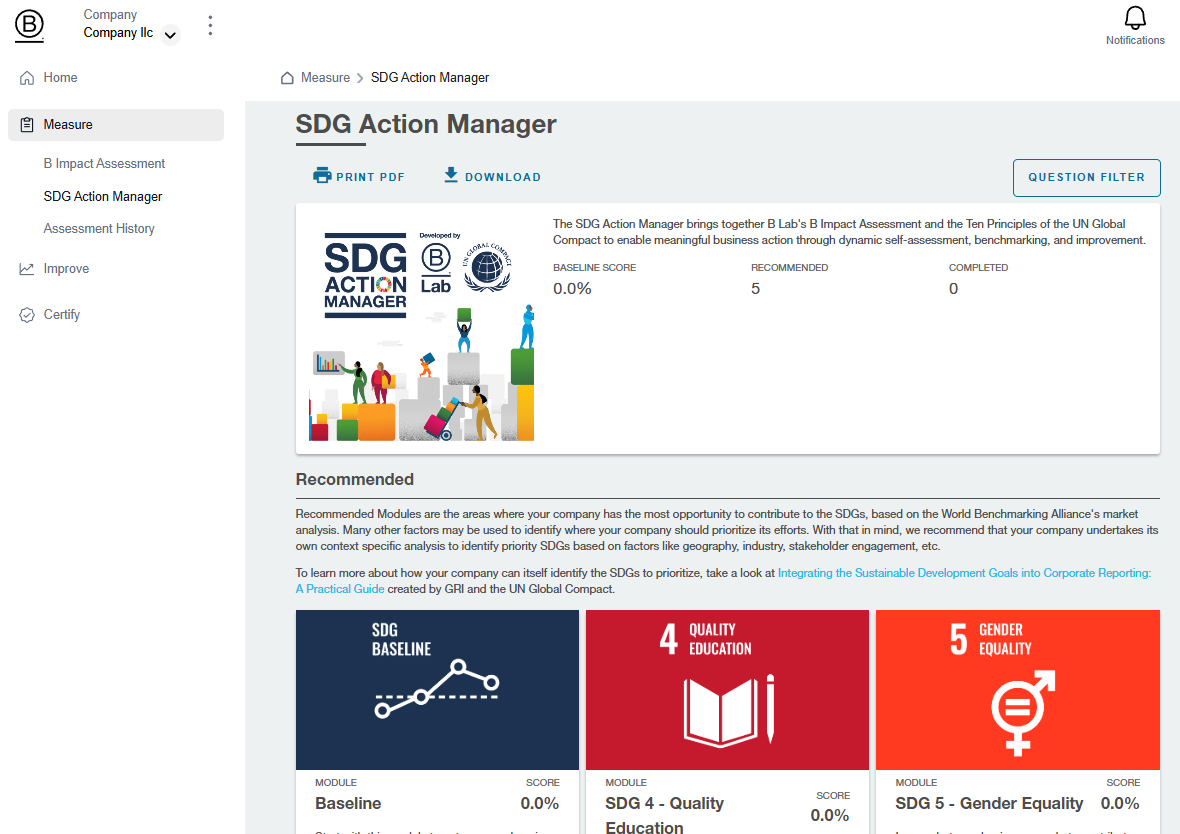
You can use the “Measure” tab to move back and forth between the B Impact Assessment and SDG Action Manager.
Now you can use the SDG Action Manager and move forward!
NOTE: Attached to this article is our technical guide on the SDG Action Manager that we invite you to consult for your knowledge.
How was it developed?
The SDG Action Manager was formally launched by anchor partners B Lab and the United Nations Global Compact in early 2018 with support of a variety of funders. Development began in 2018 and ran through 2019, with launch in January of 2020.
B Lab and The Center for Ethics and Social Responsibility (CESR) at the Leeds School of Business, University of Colorado Boulder, carried out a mapping and gap analysis of the B Impact Assessment to the SDGs. Following the mapping, questions from the B Impact Assessment that were mapped to the SDGs were reviewed and selected for each module. Simultaneously, consultations were undertaken with all Content Advisors as input into the overall structure and methodology of the SDG Action Manager. A draft methodology was dispersed to advisors for additional input along with sample modules for the Baseline Module and select SDGs, which included drafts of new questions to supplement questions from the BIA. Revisions were made to each based on input, and drafts were developed for all modules.
Following internal revisions and workshops between B Lab and UNGC on all modules, new drafts were distributed to expert contributors for each SDG in July and August. Feedback was provided for an additional iteration of content prepared for beta testing, along with the production of the online platform, ongoing development of the overall methodology, and resource tagging for supplemental resources, in November 2019. Final revisions to the content per beta tester feedback were made in December 2019, in preparation for the formal launch of the SDG Action Manager in January 2020.
Click here to log in to the SDG Action Manager and continue your journey.
SDG vs. BIA
The B Impact Assessment takes a comprehensive stakeholder-based view by evaluating a company’s impact on workers, community, environment, and customers, as well as best practices regarding governance. Users are assessed on all five stakeholder groups and cannot pick one over another. That means companies are expected to answer an average of 200 questions, which can vary depending on their size, sector and geography, in all impact areas.
The SDG Action Manager starts with a baseline module that incorporates the B Impact Assessment and the Ten Principles of the UN Global Compact related to human rights, labor, environment, and anti-corruption — essential responsibilities related to people and planet. It then advises companies on which of the SDGs they should start their journey with (the ones they can impact the most), and invites them to explore all others.
BIA
The B Impact Assessment takes a comprehensive stakeholder-based view by evaluating a company’s impact on workers, community, environment, and customers, as well as best practices regarding governance. Users are assessed on all five stakeholder groups and cannot pick one over another. That means companies are expected to answer an average of 200 questions, which can vary depending on their size, sector and geography, in all impact areas.
SDG
The SDG Action Manager starts with a baseline module that incorporates the B Impact Assessment and the Ten Principles of the UN Global Compact related to human rights, labor, environment, and anti-corruption — essential responsibilities related to people and planet. It then advises companies on which of the SDGs they should start their journey with (the ones they can impact the most), and invites them to explore all others.
SDG 17 Module
SDG 17 - Partnership for the Goals, does not have its own module. Because of its transversal nature, actions relevant to businesses from SDG 17 are embedded throughout the SDG Action Manager in the Baseline and other SDG specific Modules.
Click here to log in to the SDG Action Manager and continue your journey.
Access the SDG Action Manager
The SDG Action Manager was developed by B Lab and the UN Global Compact to help your company take action on the Sustainable Development Goals.
Sign in to your B Impact portal and you will land on the home page.
Navigate to the Measure tab.
Click “Learn More” to get to the main page for the SDG Action Manager.
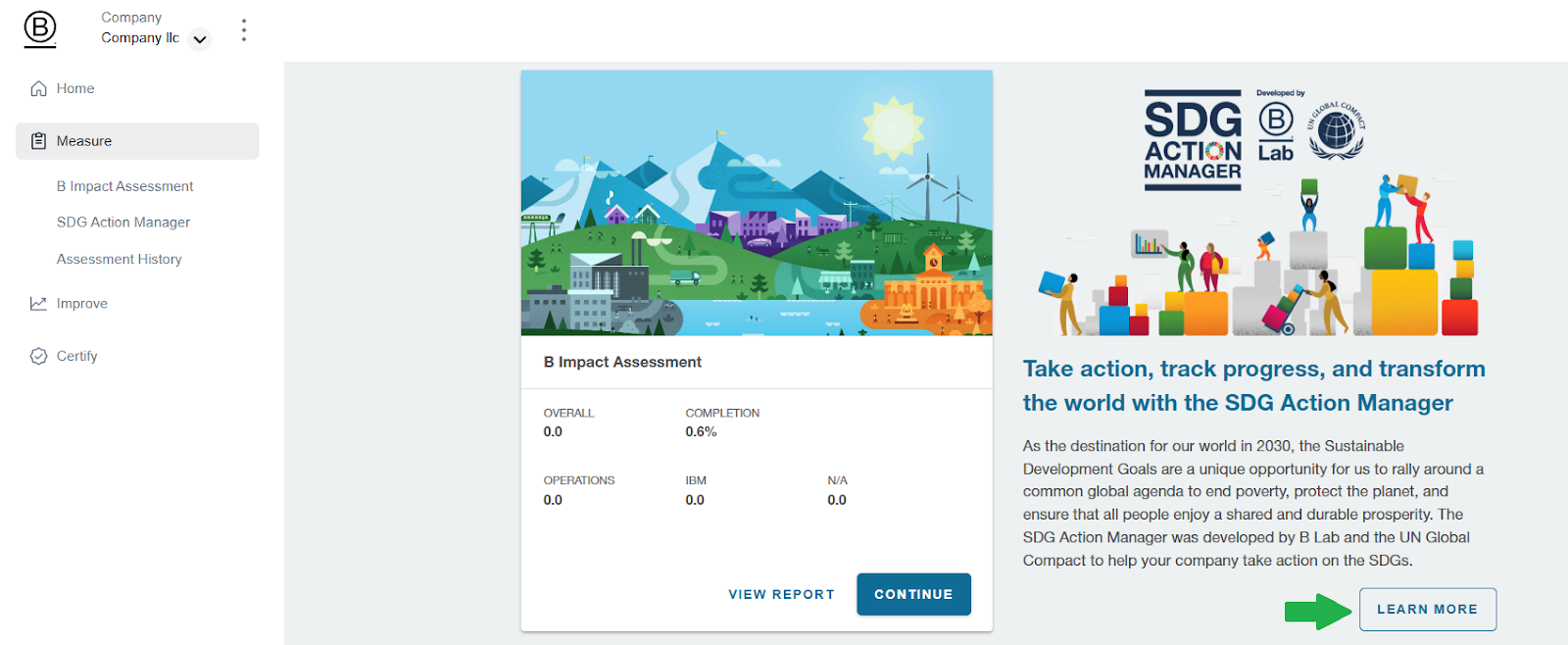
Once you do that the SDG page will populate. Click "Get Started" to navigate to the SDG action manager
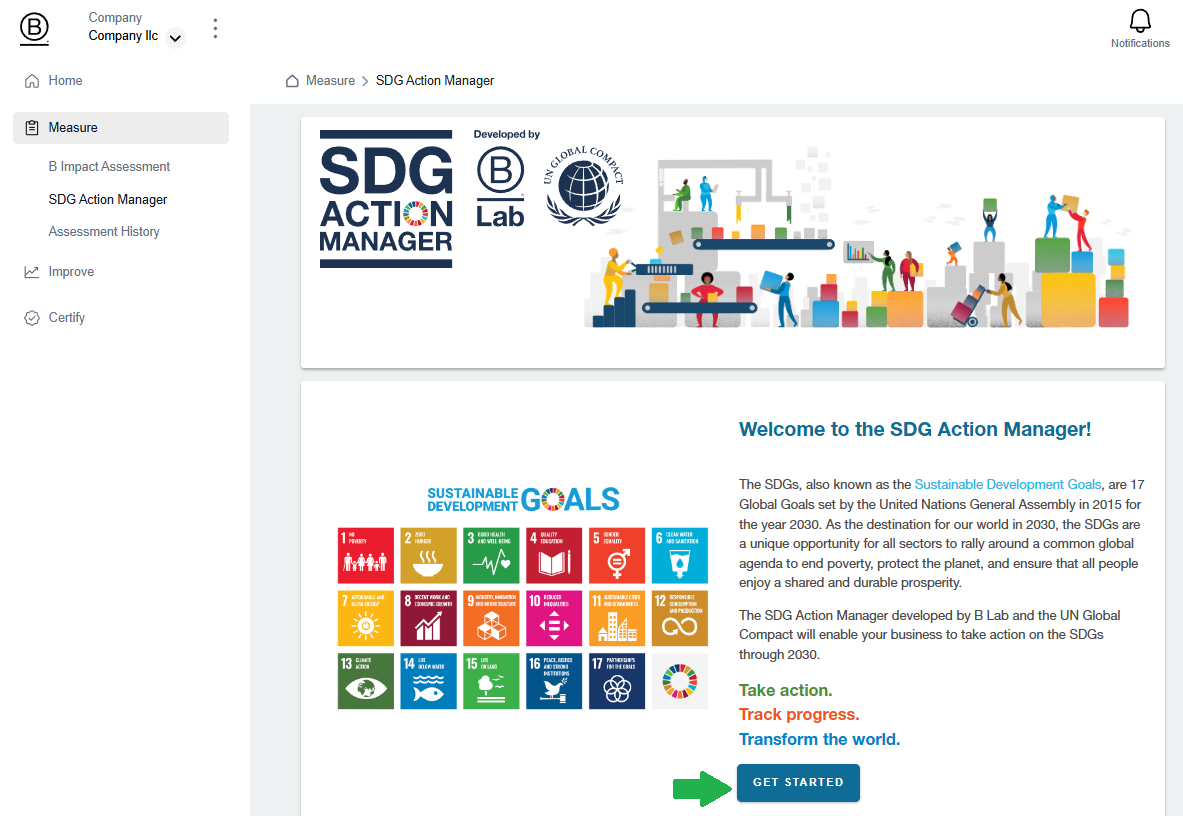
You can use these new navigation items to move back and forth between the B Impact Assessment and SDG Action Manager.
Now you can use the SDG Action Manager and move forward!
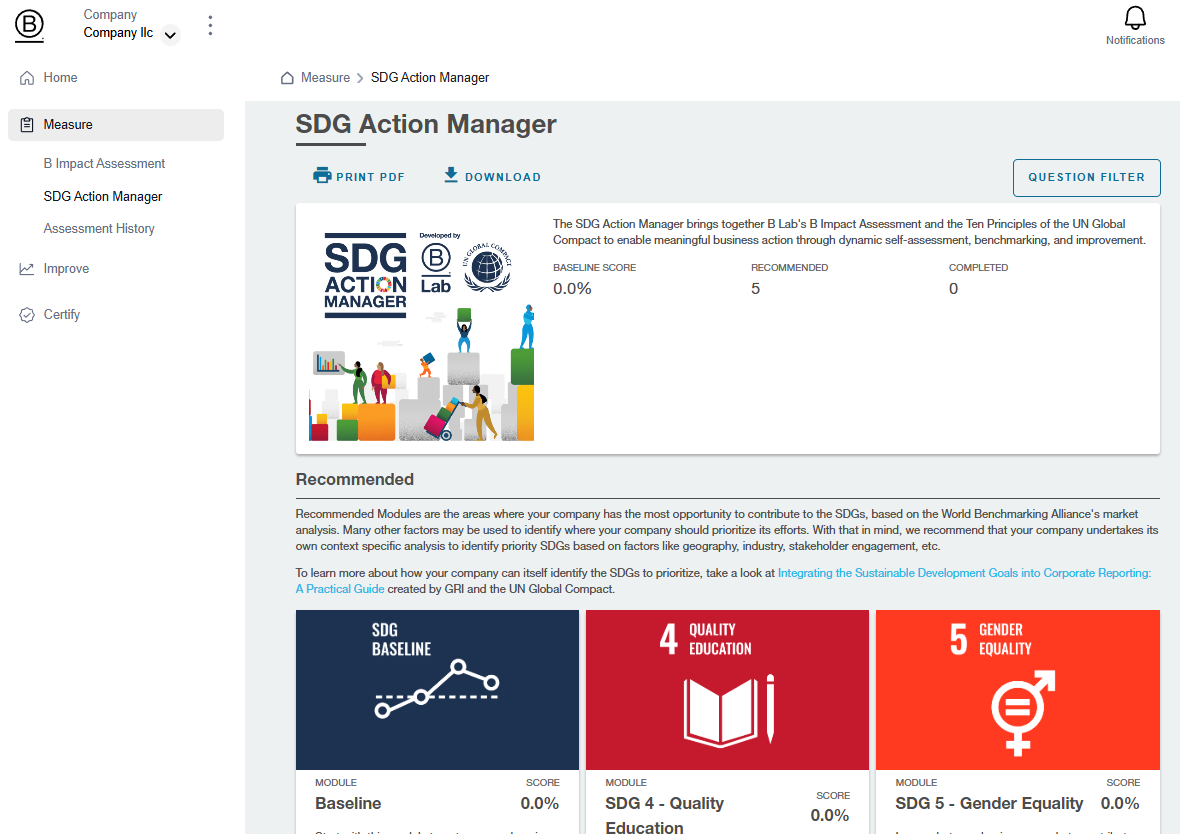
NOTE: Find attached our technical guide that we invite you to consult for your knowledge.
Interpreting your SDG Score
Performance on the SDG Action Manager for any specific module is designed to be aspirational, meaning that even high performing companies aren’t expected to earn high credit.
For context, appropriate performance benchmarks from the B Impact Assessment are the following out of 200 points:
- Median Score of Ordinary Businesses: 52 (26%)
- Qualifying B Corp Certification: 80 (40%)
- 2019 Minimum Qualifying “Best for the World” Score: 113 (57%)
Because the overall content of the Sustainable Development Goals are so far reaching, and because the design of the SDG Action Manager is to allow users to focus on modules of most relevance to them, an overall performance score for the SDGs collectively is not available. As more users complete modules in the SDG Action Manager, benchmarking will also be added to help users understand and compare their performance in the context of other companies.
Scoring for each module is presented as a percentage (0-100%), with underlying subtopics presented on a “points” basis (0-25) in order to provide an easily understandable overall score for a given SDG module while also allowing for users to more clearly track and quantify detailed performance and improvements on a deeper level. Each subtopic per module is equally weighted in the overall performance rating for that module.
Click here to log in to the SDG Action Manager and continue your journey.
SDG Modules
You do not have to complete every SDG Module. The SDG Action Manager is designed so that all users begin with a comprehensive baseline before focusing on the SDGs that are most relevant to them in order to actively manage and improve. For that reason, an “overall score” across the entire SDG Action Manager is not provided.
It is expected that users will generally prioritize between one and five SDGs.
While it is recommended you start with, and focus on, suggested SDGs, you may complete any SDG that you are interested in, once you have finished the baseline. We want you to explore the modules in a way that fits your company’s needs.
It is not recommended that you try to complete all modules in the SDG Action Manager. SDGs vary in relevance to your business. The purpose is to focus on the most relevant areas and to identify concrete actions your business can take to improve.
Click here to log in to the SDG Action Manager to continue your journey.
SDG Recommendations in SDG Action Manager
On completing the Baseline module, you will get access to the modules of individual SDGs. Within these, some SDG modules are recommended to you based on the industry in which you registered your account under. These industry recommendations are based on the critical intersections between SDGs and industries mapped by the World Benchmarking Alliance.
While a clear way to address prioritized SDGs, this method only looks at one dimension of prioritization, i.e. the industry in which your company operates. Other considerations such as geography, characteristics of workforce and stakeholder perspectives are also valuable in understanding which SDGs to prioritize, and so it is suggested that you use the Recommendations as a starting point but also consider other ways in which to identify SDGs to focus on.
To learn more about how your company can itself identify the SDGs to prioritize, take a look at this resource by GRI and the UN Global Compact.
Click here to log in to the SDG Action Manager and continue your journey.
Reporting - SDG
The SDG Action Manager has been developed as an internal management tool that can enable action and improvement. There is no verification of a company’s performance as part of the SDG Action Manager and it is therefore not designed for external reporting.
As a result, the distinct purpose and design elements of the SDG Action Manager can complement many frameworks and tools already existing or in development, including those developed by many of the Advisors of the SDG Action Manager like the Global Reporting Initiative and World Benchmarking Alliance.
Click here to log in to the SDG Action Manager and continue your journey.
Customized Recommendations
Once users complete the required Baseline Module, they will unlock access to all other modules and be able to opt into those that are most relevant to them. In order to provide guidance to users on how best to prioritize the SDGs, and help optimize usage of the platform to focus on SDGs with the most material opportunities for impact given their particular context, users will receive guidance on what modules to select. Additionally, questions are customized to a company based on the size, sector, and industry selected upon registering for the SDG Action Manager.
Click here to log in to the SDG Action Manager and continue your journey.