Audit Process
Who are B Lab’s assurance partners and why were they chosen?
B Lab's approved Assurance Partners for the B Lab Standards V2 are TO-CERT and SCS Global Services. They conduct the independent audits required for B Corp Certification.
All Assurance Partners must meet rigorous approval criteria, including ISO 17021 accreditation, the international standard for organizations providing audit and management system certification. This ensures they operate with competence, consistency, and impartiality.
- SCS Global Services is a US-headquartered organization with global reach and decades of experience certifying companies against leading sustainability standards. They are approved to certify Medium to XX Large companies. B Lab first partnered with an independent SCS subsidiary through a competitive tender process in 2024 to help develop the third-party assurance model before approving SCS Global Services as an Assurance Provider.
- TO-CERT, a subsidiary of Genashtim (a Certified B Corp headquartered in Singapore), is approved to certify smaller companies. TO-CERT has worked with B Lab for more than four years, supporting the verification of over 11,000 companies across 90+ countries. Expanding this trusted partnership helps ensure high-quality, cost-effective certification remains accessible to smaller businesses.
Both organizations were selected based on their proven expertise, independence, and ability to deliver consistent, high-quality assurance at a global scale.
How often will my company be audited?
In order to remain certified, ongoing surveillance audits and a special one-off audit in Year 3 are required, covering both Year 0 and Year 3 requirements. However, not all companies will have the same audit schedule within their five-year cycle: The frequency and type of audits that occur across the five-year period depend on the company’s specific circumstances (for example, their sector and size). Not every company site will be audited. Micro and small companies will only be audited at Year 0, Year 3, and Year 5, whereas larger companies are likely to be audited annually.
Table A.1. Audit frequency for companies in Agriculture, Service with Significant Environmental Footprint and Manufacturing sectors.
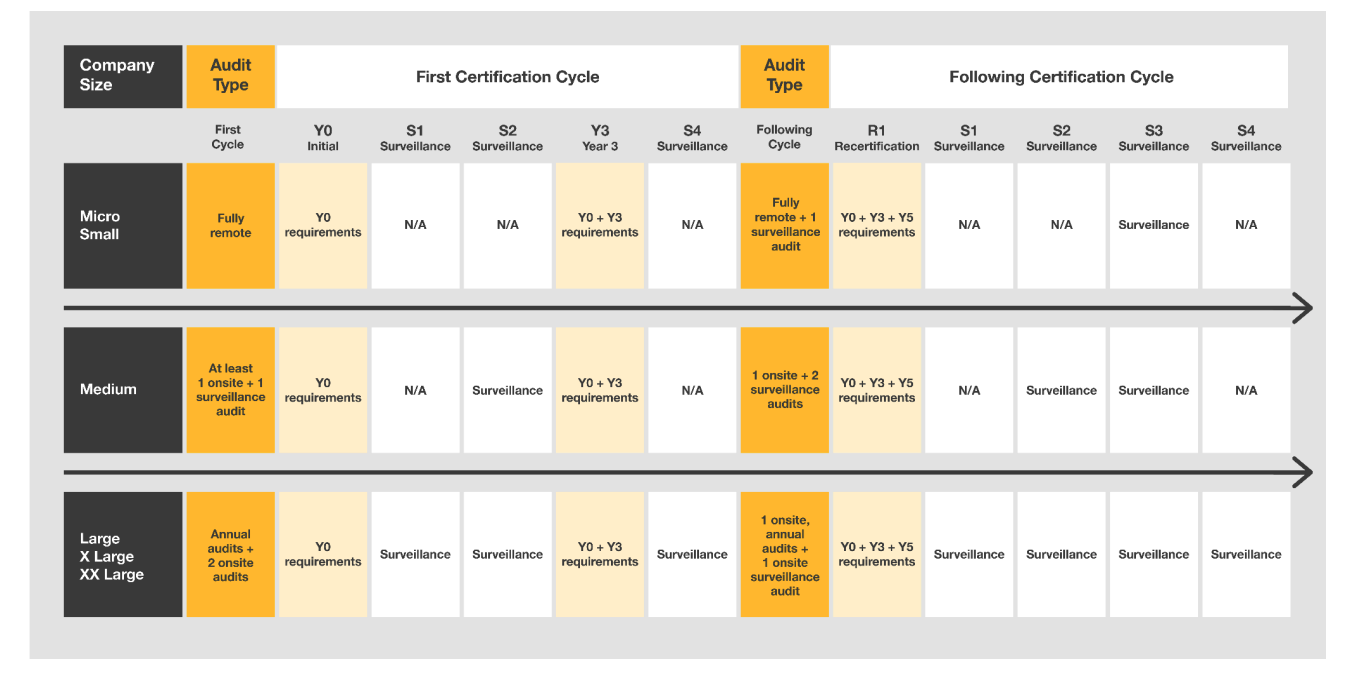
Table A.2. Audit frequency for companies in Wholesale/Retail and Services with Minor Footprint sectors.
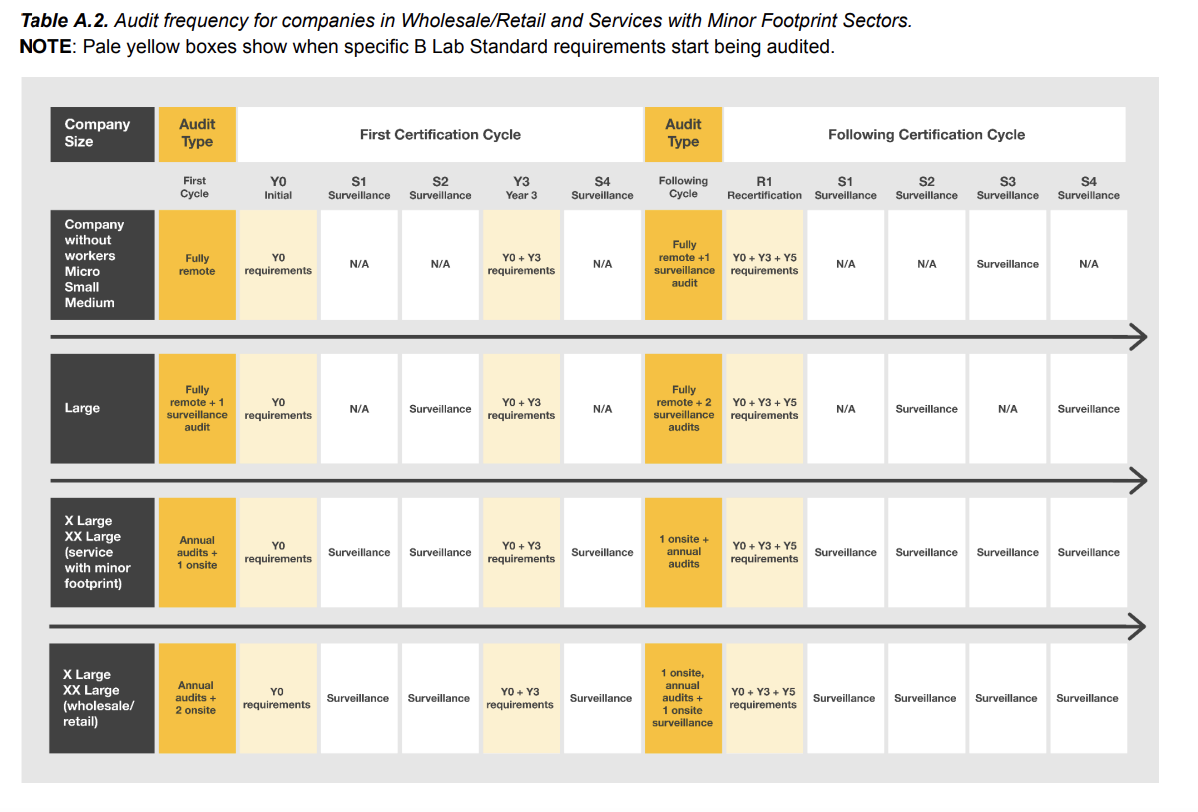
To learn more about audit frequencies, see the Certification Requirements Process and Scoping Requirements
What does the remote audit consist of?
The audit is conducted as a single-stage process, including an asynchronous review of the self-assessment and uploaded documentation, interviews, and records, it consists of five main steps:
Kick-off: the assurance provider starts with an opening meeting held by email, phone, or video call.
Document review: the assurance provider will then review your self-assessment and uploaded documentation remotely.
Check-in & evidence gathering: the assurance provider will have a live meeting with the company to discuss early results, look at confidential records (like worker pay slip information if needed), and ask for any other evidence if needed before finalising the audit results.
Wrap-up: the audit concludes with a closing meeting held by email, phone, or video call.
Reporting: Finally, the assurance provider shares their findings, and issues an audit report, including a corrective action report, to the company within 30 calendar days from the closing meeting.
What does the onsite audit consist of?
An initial onsite audit is conducted as a two-stage process:
Stage 1: Remote preparation
This first stage is done remotely and includes:
Document Check: Reviewing your self-assessment and noting any missing evidence or documents.
Readiness Check: Confirming your company is prepared for the main onsite audit.
Stage 2: Onsite visit
This must happen within three months of finishing Stage 1:
Opening Meeting: the auditor starts with a meeting on the first day.
Onsite Review: the auditor conducts interviews, reviews documents, and walks through your facility or facilities. (The assurance provider will send you the detailed schedule in advance.)
Closing Meeting: the auditor concludes with a summary meeting on the final day.
For onsite recertification audits, while this follows the same basic steps (Opening, Review, Walk-through, Closing), it is completed as a single onsite audit. The two-stage process is not required, but your updated self-assessment will still be reviewed as part of this process.
Q: How long is an audit?
A: The duration of an audit will vary depending on the audit type (initial, surveillance, Year 3 or recertification), and a company’s certification track
Generally an audit should be completed:
No more than 10 business days from the opening meeting for Company without Workers to Medium certification tracks.
No more than 15 business days from the opening meeting for Large to XX Large certification tracks.
What are the differences in the auditing process between V1.6 and V2.1 of the B Lab Standards?
The certification audit will be managed by a third-party assurance provider using a hybrid approach that combines remote and onsite auditing, with the specific type and frequency tailored to your company's certification track. We've streamlined this process into a single or two-stage approach to speed up decision-making. We use a new digital certification platform to track and manage all audit information, though you will continue to use the B Impact platform for your initial certification setup and upfront self-assessment and evidence submission. To ensure both you and the auditor are prepared, every audit begins with a comprehensive audit plan, and the V2.1 structure includes formal opening and closing meetings, dedicated time for interviews, and clear windows for submitting any additional evidence. Finally, you will receive a full report detailing conformity and nonconformity, which provides a defined timeline for closing any major or minor nonconformities.
How does third-party verification impact the cost of certification?
B Lab is reviewing pricing to align with the introduction of the new B Lab Standards and the enhanced third-party assurance model for verifying companies.
Independent assurance on the new standards will strengthen the process and credibility of B Corp Certification. B Lab is working to minimise the financial impact of price increases, particularly for smaller B Corps.
While the new model will introduce additional costs associated with third party assessments, increased diligence, and an enhanced certification experience, detailed pricing for B Corps is still being developed.
Certification fees for 2026 will be determined by the B Lab regional or country team where your company is headquartered and confirmed by the end of 2025, if not earlier.
What are the audit stage wait times?
Audit stage wait times vary by assurance provider (AP). TO-CERT services smaller companies, while SCS Global Services services Medium to XXL companies. Refer to the table below for estimated wait times for each stage in the audit process, per assurance provider.