V1.6 Verification process
Upload Documents for Assessment Verification

The Verification Report compiles a list of the selected questions from a user’s Assessment that will require further documentation and verification for the company to move forward in the B Impact Assessment verification process.
You can see questions selected in a number of ways. By navigating to Verification Reports from Reports on the left sided menu, you can see questions that have a dark Marked for Discussion icon, or dark Marked for Documentation icon.
Each question requiring documentation has:
"Explain This," "Show Example," and "In Practice" as ways to learn more context for the documentation requirement.
An Instructions section, which will open below the question, featuring specific information on how to validate that question response and template documentation. It will close once the document has been attached.
An Activity section where a user can communicate directly with their Standards Analyst by commenting and providing documentation.
To upload a document, navigate to the specific question selected for documentation and expand it. You will see an additional section titled Activity of the question now which shows the comments and documents exchanged between B Lab and the company. To upload a document click into the Comment box and two icons will appear at the bottom of this box, one that is for providing an attachment from your computer and another for providing a link to a website. You can see this under the Sample Question screenshot below.
Sample Verification Report
Sample Question

Verified question sample

About Documentation:
Materiality is determined by the question’s contribution to the company’s overall assessment score.
To navigate to the Verification Report go to the Certification Tab on the left side menu. You can also navigate here by clicking on the “Upload Operational Documents” under “Next Steps” on the Dashboard.
To improve communication between your standards analyst and you, when you upload documents, please include notes about how each document verifies the response and detailed explanation on how the document verifies the answers in the comment area. Include page numbers for long or complex documents. For questions where your response changes, please add a comment to reflect what the updated answer should be.
For confidentiality and security reasons, access to documentation is limited only to B Lab staff essential to the verification process (e.g., Standards Analysts). Like all Assessment responses, uploaded documents are kept completely confidential.
For more information on best practices for providing documentation, please see Documentation tips for the assessment.
- Security Regarding Data in the Assessment
- Security regarding your information
- Key Principles of the B Impact Assessment (see the ‘Confidential’ bullet at the bottom)
- Security Notice
- Privacy Policy
Troubleshooting:
Avoid using Chrome Incognito to upload documents. Avoid emailing documentation to analyst as well. Please submit a ticket via our KB Portal for any tech issues that arise during your Assessment Review.
Only the B Lab Review team is able to delete or remove documentation. Please reach out to the Standards team if you would like documentation removed.
Review Notifications

- About Notifications
- What kind of notification do the team members receive and when?
- 1. Submit assessment for review email
- 2. Assessment in the Verification stage email
- 3. Review Tasks emails
- 4. Goal Reminder emails
- 5. Comment Response Notification emails
- 7. Analytics Excel Portfolio data email
- 8. Improvement reminders - Review emails
- 9. Invite Team Member emails
- 10. Completion Request email
- 11. When a review is closed - Survey
- Who at B Lab is notified and when?
About Notifications
During an open Review, the B Lab Review Team will need to ask questions and verify your responses. To expedite the process, the application will display a Notifications View. In several places throughout the application one will see a "bell" icon along with a red/white number that indicates the total number of unread Notifications you have. Notifications are created when a Comment is left on a Question or a Task during an open Review.
Notifications are located in the top left hand side of your navigation. The view will be divided into two sections, Read and Unread. Notifications are associated with either a Question or Task. You can easily click to expand a Question/Task and see the Comments section. From there you can send along your reply.
-Users are not defaulted into notifications. They need to opt-in. If they are submitting for certification, there is a requirement that at least one team member has enabled notifications
-When users opt-in to notifications, they have an option of "copying" other users notifications.
It reads:
Other team members may have existing notifications. Would you like them displayed in this users' Notifications view?"
Your Company's team members with notifications enabled (designated via Settings -> Team Members) will receive a Notification any time someone outside of your company Comments on a Question or Task.
What kind of notification do the team members receive and when?
1. Submit assessment for review email
(Every time a new assessment is submitted)

2. Assessment in the Verification stage email
(When the application progresses to it verification stage)

3. Review Tasks emails
A. "No company actions required"
Whenever all reviews are open for more than one month and less than two years with no tasks assigned to the company, and in Evaluation Queue, Evaluation or Verification Queue stages
these companies will receive a communication that nothing is required of them and will be provided with resources to help them prepare for the rest of the review

B. "The company has overdue tasks to be completed"
C. "The company has due soon tasks to be completed"
(2 weeks before the due date)
D. "The company has recent tasks assigned to them"
(Sent one day after the task is assigned/created)

4. Goal Reminder emails
Goal reminders are sent monthly depending if the user selects "Receive Email Reminders"
Goals on hidden questions are ignored
Only send to the latest goal

5. Comment Response Notification emails
- Are sent nightly to teams member for each of their account
- Are emails sent specifically to a company users who have notifications enabled
- Are only sent if the response notification comment is not read yet
- Are only sent once
- Are only sent to companies team members
IMPORTANT: it does not mean that the team members will receive a notification when a new comment is added to a task.
Our task-communications will be sent out based on Assignment of the task to the company AND the Due Date of the task.

6. Re-certification email
- Are sent to users recertifying in 3 months

7. Analytics Excel Portfolio data email
(sent monthly)
8. Improvement reminders - Review emails
- 45-day improvement reminders
- 90-day improvement reminders
- 60-day paused reminders
- 90-day paused reminders

9. Invite Team Member emails
(Every time a new team member is added)

10. Completion Request email
When the last task in a stage is closed, that stage and possibly the next stages with 0 tasks are automatically closed.

11. When a review is closed - Survey
(Every time a review is closed)

Who at B Lab is notified and when?
Who at B Lab gets notified about a Comment is based on the Review Stage. For Questions, when a company adds a comment, the notification is sent to the B Lab Review Team based the currently active Review Stage:
| Evaluation Queue | Evaluation | All Other Stages |
| Notifications must be sent through the KB portal and will be forward to the respective Global Partner | Notifications will be sent to the B Lab Evaluation Analyst | Notifications will be sent to the B Lab Primary/Secondary Verification Analyst or Evaluation Analyst if neither are set |
For Task Comments, the B Lab Review Team member notified depends on the Stage that contained the Task being Commented on.

Interacting with Tasks During Your Review
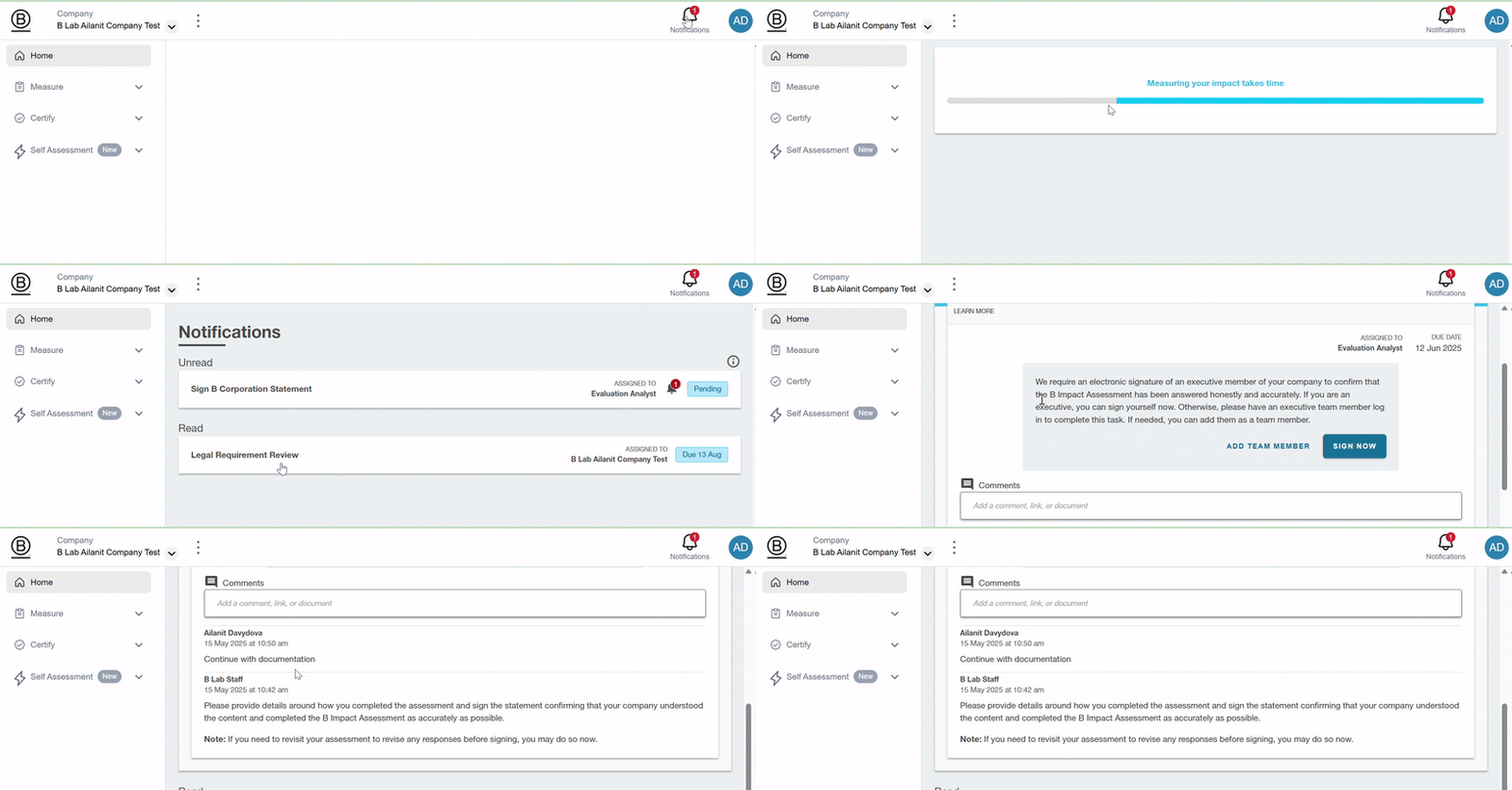
Throughout the review process, you will be required to complete certain Tasks, some of which request that documents be uploaded to them. You can find all of the notifications on the top right corner of your screen. Clicking on the bell icon will present a page of Unread and Read notifications.
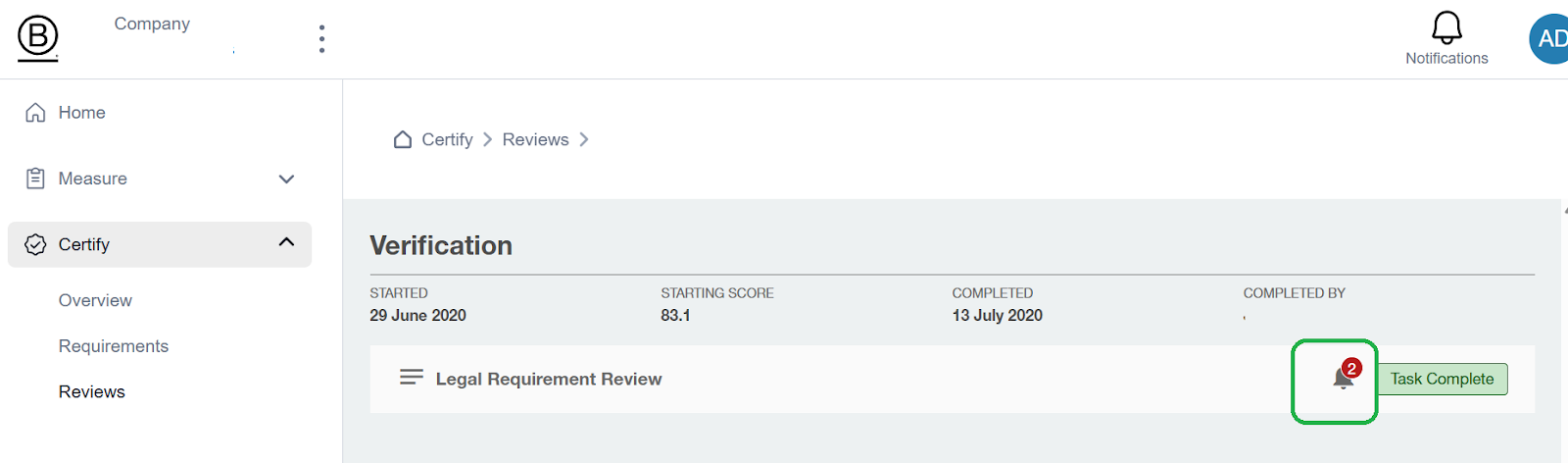
The Reviews page under the Certify tab on the left side, will show you what stage of the process you are currently in, as well as a list of current and future tasks. If any tasks require action from you, they will have a notification bell attached to them
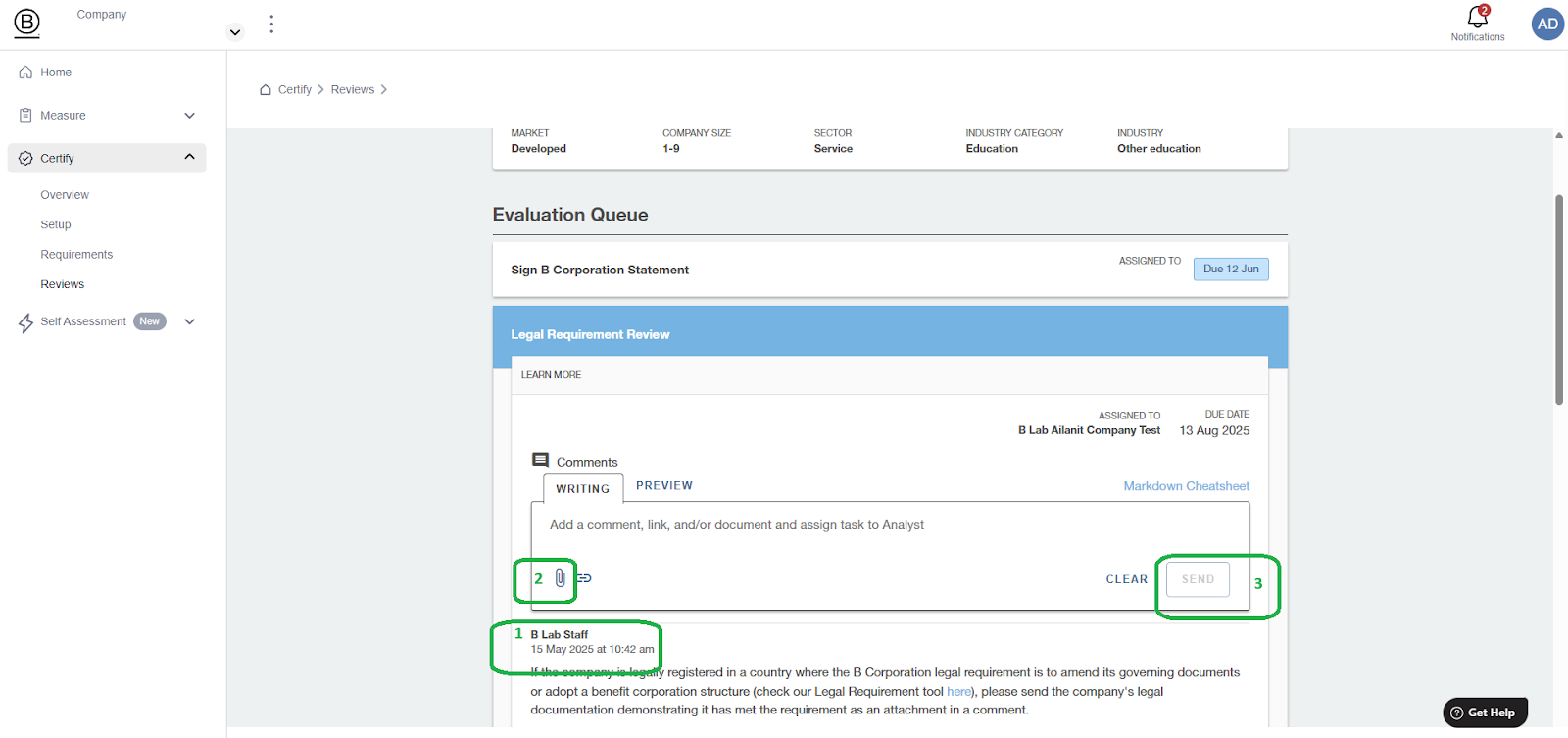
Clicking on a Task will expand it and open up the activity section. You’ll find comments and/or instructions from B Lab Staff here (see: 1). If a document upload is being requested in the comment, click on the paperclip (see: 2), select the requested document from your device, provide a brief description of what the document contains, and then be sure to click the Send button (see: 3)
The platform will notify your analyst when you complete certain tasks or upload documents. Therefore, it’s important that you upload requested documentation within the application and DO NOT send documents via email.
The Notifications list will show any tasks or questions that were commented on by B Lab staff and that likely require something from you. Once you expand them, the notification bell will disappear. However, they will remain marked as “Read” on the Notifications tab until your review closes.
Completing Your Operational Highlights
Instructions
Your Verification Report has a customized list of questions based on your responses in the B Impact Assessment(BIA) for which your company is scoring highly. Please select two questions in each Impact Area section of the BIA (i.e. Governance, Workers, Community, Environment, and Customers) and tell us more about your company’s practices related to that question topic.
Select the questions that you want to highlight. Under Activity, type your responses under Comments and click Send when complete.
Note: If there are fewer than two questions in an Impact Area, comment on as many as appear; you do not need to comment on additional questions in other sections. If there are more than two questions in an Impact Area, you may choose which practices you would like to highlight for us. For instance, Operational Highlights may represent practices you:
Currently report or market publicly (on website, social media, impact reports, etc.).
Are most proud of.
Recently implemented to improve the company’s social or environmental impact.
Believe to be unique for your company’s industry, size, geography, etc.
Like the entire BIA, Operational Highlights should only represent implemented practices, and not future plans. If you notice your response does not apply yet, add that as a Comment for your reviewer.
Comments should provide B Lab with an understanding of that practice at your company to help us in the review of your company’s BIA. Please Include what the practice is at your company, to whom it applies, when it was implemented, and context as to why you are proud/it’s unique, if relevant.
To assist you in completing this step, below is an example of a completed Operational Highlights for Review.
You will have an opportunity to discuss any question with your Standards Analyst on an Assessment Review call shortly after completing your Highlights commentary. If you have questions about this process that cannot wait for the review, feel free to submit a ticket to our B Lab Global Support team via our KB Portal.
Examples
Below are screenshots with examples of how to select and comment in the Verification Report to questions that represent Operational Highlights for your business.
Selecting Questions to complete the Operational Highlights step in the certification process

Since this Impact Area (Governance) only has one available question, you are only required to provide a comment on that single question. Likewise, if an Impact Area does not contain any questions or it does not appear on your Verification Report- you are not required to respond to any questions from that section.
When there are multiple questions available in an Impact Area, please select 2 questions to provide Comments with additional details. (I.e. In the Workers section above, you would select only 2 out of the 4 questions of your choice to comment as an Operational Highlight.)

When you decide which questions in the Verification Report you would like to select as an Operational Highlight, expand the question and enter your answer rationale in the “Activity” section. Note: Please remember to click “Send” in order to submit your comment.
Examples of Comments to complete the Operational Highlights step in the certification process:
Below are a list of questions in each Impact Area and a sample Operational Highlight Comment that provides supporting information regarding that practice for B Lab’s review process.
Governance
Question: Social/Environmental Key Performance Indicators
Response: We measure social and environmental outcomes over time (examples: 3rd-party impact assessments, progress out of poverty indexing, beneficiary outcome surveys, etc.)
Sample Comment: One of our company’s values is to be good for society and the planet. Three years ago we developed social and environmental metrics around the Sustainable Development Goals. Some examples of metrics include: planting more trees in our facilities to offset our GHG emissions and allocating 10% of our building projects towards sustainable, resilient infrastructure projects for underserved communities. We publish an annual report where we report our outcomes from these goals, which is linked on our website here [www.companywebsite.com/annuareport].
Workers
Question: Supplementary Health Benefits
Response: Options 1-3, 5-6
Sample Comment: We have an Employee Handbook that outlines the benefits we provide to our employees, which include: dental insurance, life insurance and short and long-term disability. These benefits are provided by and paid for by our company. All staff (full time and part time) and their dependents are eligible for these benefits upon hire. At this time 100% of staff have registered for these benefits.
Community
Question: Impactful Banking Services
Response: Options 2, 5 and 6
Sample Comment: The majority of our company’s assets are managed by ABC Bank. We have banked with ABC Bank for the past five years. ABC Bank is located in our town and is privately owned. ABC Bank is also a Certified B Corporation. We choose this bank because of their commitment to our local community and their shared values of inclusivity and sustainability.
Environment
Question: Environmental Management Systems
Response: Options 1-3
Sample Comment: We conduct an internal environmental audit every year that measures the following metrics: water usage, energy usage, greenhouse gas emissions and waste produced. Our Chief Operating Officer manages this audit and publishes the data into a report she sends to the entire team. The report is also used by management for goal setting and to determine operational strategies. Last year, the EMS audit motivated our company to install a composting bin in our office to reduce waste and to have more virtual meetings to reduce our carbon footprint.
Impact Business Model Documentation Tips
This article provides tips for how to successfully document question responses for ‘Impact Business Models’ (IBMs). Documentation is requested during the review process to verify IBMs due to their score weighting. Documentation provides necessary evidence to ensure a company’s full impact is appropriately reflected.
For general information about IBMs, uploading documentation, and general documentation guidelines please see the linked articles. Guidance on specific questions can be found at the question-level by clicking on ‘Learn’ or ‘Documentation Instructions’ when a question is marked for documentation.
About Documentation
A question requires documentation for verification when it is marked with a cloud icon.
Comments should accompany all documents and are used to clarify which answer option/s the document verifies, what the document is, context that will be helpful to understand it, and references to page numbers where supporting information can be found. Comments, alone, are not considered sufficient documentation.
Rely on documents already utilized by your company first. In some cases a question may provide a `Documentation Template` or the Verification Analysts may request the company complete a template.
Multi-pick questions, meaning questions that allow multiple answer options to be selected, require documentation for each selected answer option.
If at any point in the process you realize that a question or IBM does not apply, please feel free to leave a comment stating this.

Please find below types of IBMs, a comprehensive list of IBMs in each Impact Area, types of questions that require documentation, suggestions of documentation to provide, and a linked document with screenshot examples.
Products and Services IBMs
Several IBMs, referred to as products and services IBMs, capture the financial significance of an impactful product or service within the company’s overall revenue. These IBMs are scored according to three types of questions, including ‘description’ questions, ‘revenue’ questions, and ‘outcomes’ questions. ‘Description’ questions and ‘revenue’ questions are called ‘calculated questions’ and scored through an internal back-end calculation.
‘Practices’ IBMs
‘Practices’ IBMs capture significant and impactful in-house programs, such as manufacturing processes, purchasing practices, or employment programs, but do not necessarily reflect a revenue generating product or service. These IBMs are made up of four types of questions, including ‘prerequisite’ (gating) questions, ‘practice’ questions, ‘percent’ questions, and ‘outcomes’ questions. ‘Practice’ questions and ‘percent’ questions are calculated questions, and scored through an internal back-end calculation. Screenshots of examples for each question type can be found here.
Please see the attached PDF for ‘Practices’ IBM descriptions and specific documentation recommendations, additional information and definitions, and question type examples.
Review Approach
Purpose: This article explains what is the Review Approach in the B Corporation Certification process.
What is a “Review Approach”?
After completing the B Impact Assessment, eligible companies interested in pursuing certification undergo a review process with B Lab to determine if they meet the performance requirements (a verified score of 80) for Certification.
The Review Approach determines the typical tasks that are required for the review process, along with expected timings, based on company characteristics. These tasks have been calibrated in order to adequately verify the B Impact Assessment (BIA) for companies of different characteristics and contexts.
Each Review Approach is intended to move the company through the review process as effectively and efficiently as possible based on that company’s characteristics.
How do I determine the Review Approach that applies to my company?
Several characteristics determine the Review Approach most appropriate for the company. These characteristics include:
Size based on earned revenue in the last fiscal year
Size of the company based on number of full-time equivalent employees
Ownership and corporate structure of the company
The industry in which the company operates (and whether this industry is considered controversial by B Lab; see here)
BIA scoring profile, meaning the combination of the company’s points in Operational and Impact Business Model questions (learn about the differences in these questions here)
The Review Approach is often determined upon submission once the Reviews page becomes available, but may be adjusted as B Lab learns more about the company.
If you’ve already submitted the assessment, please find your Review Approach and your required tasks on your Reviews page. Note that B Lab reserves the right to adjust the Review Approach and add tasks at any point in the review process to ensure an adequate review.
B Lab: Company Code of Conduct

B Lab values relationships built on empathy and respect among prospective and existing B Corps and employees and representatives of B Lab. These relationships occur with people from all over the world that work together to use business as a force for good virtually, on calls, and at times together in-person.This Code of Conduct outlines our guidelines for such relationships and applies to all interactions of representatives of companies using B Lab’s products and services with B Lab representatives.
B Lab may update this Code and its internal enforcement process at any time based on feedback of B Lab representatives and company representatives.
Our Ask of You
By interacting with B Lab representatives and using B Lab products and services, you agree to:
Act in a professional, courteous and polite manner
Respect different viewpoints and identities of B Lab representatives
Treat counterparts with respect, including when giving and accepting constructive feedback with respect to, but not limited to, results in BIA score changes, and in some cases, inability to achieve or maintain the certification
Respect the time of all parties by adequately preparing for and being punctual in attending calls and meetings
By interacting with B Lab representatives and using B Lab products and services, you agree to refrain from:
Using profane language or aggressive or hostile behavior
Being uncooperative or unwilling to use appropriate channels for communication and adjudication (e.g. Leave Feedback survey tool, comments in the B Impact Assessment platform, standard appeals process)
Harassing B Lab representatives (physically or verbally)
Sharing explicit, implicit or oppressive insults or derogatory comments or other biased behavior based on the identity of the B Lab representative
Disregarding, concealing or engaging in conflicts of interest
Offering, soliciting or accepting bribes of any kind
Interfering with B Lab’s practices to uphold our Privacy and Confidentiality policies (e.g. requesting workarounds for expedited service, inappropriately sharing personal data or privileged information)
Engaging in any illegal behaviors that cause reputational risk and/or damage to B Lab
Exhibiting other conduct that is inappropriate in a professional setting
Our Promise to You
All B Lab employees and representatives acknowledge this Code of Conduct before embarking on external relationships. You will be treated with professionalism and courtesy. We will share information with you transparently and honestly. We will come to meetings prepared, arrive punctually, and respect your time.
How to Report Conduct Violations
If you experience a violation of this Code of Conduct, report the instance via the Leave Feedback survey at any time. Employees or B Lab representatives who are alleged to have violated this Code of Conduct will be subject to an investigation and performance review led by the People & Culture team per company policy.
B Lab representatives have the authority to provide company representatives verbal or written warnings, or feedback, before escalating an incident for investigation. B Lab representatives can report violations to this Code of Conduct to the B Lab Global Lead Executive. Companies who are alleged to have violated this Code of Conduct will be subject to an investigation by the B Lab Lead Executive. If behavior is found to violate this Code of Conduct, the company may be deemed ineligible for certification or the company’s review may be paused for six months. At that time the company can reapply (including paying any applicable resubmission fees).
Background
B Lab makes decisions on companies’ eligibility for certification, the answers that companies provide in the B Impact Assessment (BIA), and subsequent verified scores. Example interactions include, but are not limited to, phone calls and written communications during the B Corporation Certification process, customer support, and investigations of public complaints of Certified B Corporations. B Lab employs qualified analysts who complete in-depth training to make decisions in line with BIA and B Lab internal guidance or receive additional guidance when needed, and are subject to quality assurance mechanisms. These measures allow B Corps to benefit from the credibility of the certification.
As an organization transforming the global economy to benefit all people, communities, and the planet, B Lab takes seriously its responsibility as steward of the B Corp Certification and BIA standards. We are committed to creating working relationships that are centered on wellness and Justice, Diversity, Equity, and Inclusion (JEDI); supportive of our mission, and grounded in trust.See more information about our JEDI journey here.
We invite prospective and existing B Corps to also engage in a JEDI learning journey to uphold the credibility and benefits of B Corp certification. We would be happy to share our experiences and resources with you.
Documentation tips for the assessment
Formalizing policies
Whilst working through the B Impact Assessment (BIA), you might come across questions that refer to a policy or practice that your company does but hasn't got a formal written policy on. During verification, your analyst will be looking for formal written policies (e.g. in the employee handbook) for any questions referring to policies, as this is crucial for ensuring their longevity. As you’re checking your BIA, make sure you have formalized any policies which you claim to have in place.
Upload Standardized Documentation
Depending on your company size, you may be required to complete the “Upload Standardized Documentation” task prior to starting verification. This task will require you to upload:
The company's income statement (i.e. Profit & Loss)
The company's Employee Handbook (if it has one)
The company's Supplier Code of Conduct or screening criteria (if it has one)
This task will also require you to complete a template with information about your employees and suppliers. The template has been designed so that the information provided can be used to verify multiple questions within the assessment.
Employees
Please list all workers that were working for the company at the time of the B Impact Assessment completion and all workers that were in the company 12 months before the date of reference used to complete the B Impact Assessment. Also, include in the list all workers that started and left the company during the 12 months reported. Please use the same date of reference that was used when collecting data and answering the B Impact Assessment. You may redact employee names and use anonymous identifiers instead.
Suppliers
Please use the last fiscal year to complete this information, ensuring that the fiscal year aligns with the reporting fiscal year of your B Impact Assessment. You must list enough suppliers to ensure that at least 80% of the company’s total expenses in the last fiscal year are accounted for, excluding labor, bonuses, rent and utilities costs. Costs from labor benefits (e.g. private health insurance supplier) should be included. Independent contractors that are not considered workers within the BIA (i.e. do not work indefinitely or greater than 20 hours per week for + 6 month period) should also be included.
Revenue
You will need to provide evidence of the company’s revenue during the reporting fiscal year of your assessment, typically in the form of your Profit & Loss. The reporting fiscal year questions should be answered according to the fiscal year that most recently concluded at the time of beginning the assessment, and for which financial data is available. For example, if you are beginning the assessment on January 15, 2024, and your company’s fiscal year runs from February 1 to January 31, you may use data from the fiscal year that ended January 31, 2023. However, if financial statements for the fiscal year that ends on January 31, 2024 are finalized before you submit your assessment, you may choose to update your responses to questions referencing the last fiscal year. This is optional.
Areas to align the fiscal year include the products and services section of the company details page, the governance metrics section (particularly the last fiscal year and revenue last year questions), any other questions throughout the assessment relating to the last fiscal year and revenue questions within Impact Business Models.
Impact Business Models (IBMs)
Note: this IBM guidance is based on the most common scenarios and further documentation may be requested during verification.
This documentation does not have to be uploaded at the point of submission and you will be notified when this is required.
Governance
The only documentation you will need in order to gain 10 points under the Mission Lock IBM is your amended governing documents (e.g. Articles of Association). More information on how to amend these documents can be found here.
Workers
The two IBMs within the Workers impact area are Worker Owned and Workforce Development. For the Worker Owned IBM you will need evidence that the company is >40% owned by non-executive employees. The documentation required could be evidence that the employee trust owns >40% of the shares in the company and that all employees are able to join the program. It could also be a spreadsheet which includes the following details:
Non-executive employee name or identifier (e.g. Owner 1, 2, etc.)
Employee job title
Number of shares owned
Type of ownership held (i.e. stock, stock options, stock equivalents)
Total amount of all company shares owned
You will also be required to provide documentation to illustrate the governance structure that your company has set up to enable employees to make substantive decisions that impact the direction of the company. Typical documentation required would be an employee handbook, policy, etc. that details the responsibilities of the governing body and how employees nominate or elect representatives.
For Workforce Development, you will need to provide detail about the chronic barrier to employment your company is trying to address and the program the company has in place to target this specific group during recruitment. You will also need to provide a list of workers that have this barrier to employment, with the following information:
Evidence that they are paid the living wage (e.g. a list of employee salaries)
Notes about which employee is full time, part time, temporary or informal
Evidence of professional or technical training provided
Evidence or anecdotes of rehiring seasonal or day workers (if applicable)
Community
Typically, for Community IBMs, such as Designed to Give and Local Economic Development, the documentation required will be formal written commitments to meet certain thresholds and evidence that the commitment has been met in previous years, in particular, the reporting fiscal year of your assessment. The formal commitments should either be publicly available (e.g. on your website) or an internal policy signed by an executive.
For Supply Chain Poverty Alleviation, depending on which areas of the IBM you are gaining credit for, you will typically need the following documentation:
Documentation demonstrating a quantifiable increase in productivity/efficiency of your small-scale suppliers due to your capacity building services
Copy of training materials or photograph depicting training provided to suppliers
Copy of contract or agreement demonstrating that the contract price was partially or fully paid in advance to significant suppliers
Copy of contract or agreement demonstrating contracts for input materials are signed and executed in advance for the next year with significant suppliers
Evidence of fair-trade certification of suppliers, such as a copy of supplier fair trade certification(s) or photographs of the Fair Trade Certified logo on products from suppliers
Additionally, you will need to provide documentation detailing the percent of total Cost of Goods Sold spent on products that are sourced through small-scale suppliers (suppliers or cooperatives with supplier members that have fewer than 50 employees) and indicate which of the above is relevant to each. You may upload a spreadsheet or list of all of your suppliers and the amount spent with each, indicating those that are small-scale suppliers.
Environment
In most cases, the documentation that would be required for Environment IBMs is evidence of 3rd party certifications to back-up your claims that your products or services have a positive impact on the environment. For example, if you claim that your products are organic, you will need to provide evidence that your products have been organic certified by a 3rd party (e.g. Soil Association Organic Certification). You will also need to provide a breakdown of products or services that have the certification, which should align with the reported revenue within the IBM.
If you do not have a 3rd party certification to support your claims, other documentation may be acceptable. For example, if you are claiming that your products reduce energy, water, waste or GHG emissions, you can provide documentation that shows that your products are a clear alternative to another product and that your type of product has substantially reduced emissions (e.g. life-cycle analysis).
The Environmentally Innovative Process is designed differently and requires some more specific and extensive documentation and research, including:
A comprehensive Environmental Management System that measures energy, water, waste and carbon emissions with objectives and targets
Extensive research into the industry with particular focus on why the issue that you are addressing is of significant concern in your industry
Benchmarking data comparing the company’s environmental performance with other companies in the industry or the industry in general
Evidence that the innovative process is truly innovative and you are an industry leader in developing and implementing this process
Data that shows that the innovation affects the majority of the company’s products or services and significantly reduces the total environmental footprint of the company
Customers
The Customer IBMs are quite varied, but the documentation should clearly show what the positive outcome is for your customers and, if applicable, evidence that your customers are underserved individuals or businesses. You will also be required to upload data that shows the percentage of revenue generated from your products or services that can be attributed to the positive impact you are creating for your customers.
If you are asked for documentation to show that your end beneficiaries are underserved individuals, you must have evidence that these individuals have a specific characteristic that would always categorize them as underserved, taking into account the context in the region your company operates in. For example, if your customers are women, that would not be enough evidence to gain credit, as not all women in the UK are underserved. However, if you can provide evidence that a percentage of your customers are low-income individuals, then you would be able to earn credit for serving low-income individuals.
The key to the documentation for the Customer IBMs is that you track the end beneficiaries of your products or services so that you can evidence who they are and what the positive impact is.
Time periods to consider when completing the B Impact Assessment
It’s important to identify an appropriate and consistent time periods for your answers to the B Impact Assessment (BIA), as it provides a “snapshot” of a company’s social and environmental performance at a given point in time. Please refer to this article to understand the types of time periods that should be used when answering and uploading documentation for questions in the B Impact Assessment.
Brand Review Overview

Many companies offer more than one distinct brand of products or have different legal entities within their structure. This usually happens whenever there are multiple legal entities with different trading names grouped together in one certification, for example, under a parent-subsidiaries structure or in assessments that contain product lines with distinct names/brands. In order to prevent consumer confusion on what is B Corp-certified, B Lab ensures the B Corp Intellectual Property (IP) is only used by companies and its related brands that meet the B Corp certification requirements independently.
To that end, B Lab has created a pathway – Brand Review – for brands that do not share the certifying entity’s name to use the B Corp IP independently. This allows companies to potentially market their B Corp status through channels such as packaging, websites, and other related communication across their portfolio of brands. The B Corp certification remains a company level certification, and not a product level certification. Therefore, the use of the B Corp logo for individual brands is always linked to a company certification and its B Corp profile.
What does a Brand Review entail?
If a certifying company wishes to use the B Corp IP in its portfolio of brands, the company should communicate this need to the Verification Analyst at the beginning of the Verification process by providing the list of the desired brands to be considered for the Brand Review.
At the end of the verification process, with the company’s final score confirmed, a Brand Review is conducted by the Verification Analyst for the brands requested by the company.
The analyst verifies whether the different-name brands meet the B Corp Certification requirements, which means that each brand should individually score 80 points or more on the B Impact Assessment (BIA).
The Brand Review results are communicated before the company’ certification is closed. It includes each brand’s individual score, including brands that might or might not use the B Corp IP independently and guidance regarding the correct B Corp IP usage for these brands.
How is a Brand Review conducted?
For the Brand Review, B Lab calculates the company’s base score. This consists of Mission Lock + points from Operations questions + N/A points.
Note: The operations score and N/A score can be found on the BIA dashboard. The dashboard can be accessed through the left ribbon of the company’s BIA page.
If the company’s base score is above 80 points, all brands and/or entities in the scope of the assessment meet B Lab’s Certification requirements automatically.
If the company’s base score is below 80 points, the Verification Analyst will determine each brand’s BIA score by checking its qualification for each Impact Business Model (IBM) that the certifying company has earned, and calculating its participation in each IBM score. In this case, B Lab will need access to each brand’s financial figures in order to complete the process.
When can companies request a Brand Review?
Companies with revenue below USD1B are only eligible for Brand Review during the B Corp certification or (re) certification process. B Lab does not offer Brand Review to these companies in between the certification cycle.
USD1B+ revenue companies: If a Certified B Corp with more than $1B in revenue wants to use the B Corp logo for newly launched brands, a new acquisition or a newly created subsidiary (with a different name from the Certified Parent) after certification, B Lab can perform a paid mid-cycle Brand Review to determine whether certification requirements are met independently. Please contact the B Lab Global Partner in your region for further information.
New brands created or acquired during certification or from acquisitions
If a company is certified with a base score > 80 points, the company may use the B Corp IP in connection with newly created or acquired brands at its own discretion. These brands will be evaluated at the next certification term and must meet the performance requirement independently in order to continue use of the B Lab IP in subsequent terms.
If a company is certified with the base score (ML+OPS+NA) < 80 points, the company is not encouraged to use the B Corp IP on the new brands. It is recommended to wait for the next certification cycle to have these brands formally included in a Brand Review. (exceptions are for USD 1B+ revenue companies that can request a paid mid-cycle Brand Review).
Pricing
Standard Approach: Companies on the Small, Small-Medium and Medium Enterprise Approach
Companies can have up to 3 brands (name on the B Corp Profile + 2 additional different-name brands) included in the Brand Review process - covered by the company’s verification fee. Additional brands have a fee. Each additional batch of 3 brands costs USD 500. The fee structure is as follows:
Brands 1-3 is USD 0
4-6 brands are USD 500 total
Next 7-9 are an additional USD 500 total and so on
Large Enterprise & MNC Approach:
Brand review pricing is factored into the company’s verification fee. A company can request as many brand reviews as desired. Mid-cycle brand review pricing is available on request for USD 1B + revenue companies.
.
Assessment Submission: Operational Date Explained
How to determine when your company’s operations started:
The “start” of a company’s operations can be defined in many ways across the business community. Because of this, our definition is meant to inform how it is applied based on the scope of the B Impact Assessment. The beginning of business operations are not synonymous with when the company was founded or registered officially.
We define your operational date as the initial date in which can be either of the following options:
1. Had at least one individual contributing greater than 35 hours per week to the company (including working owners)
2. Was formally engaged with a supplier or client.
If you are not operating fully yet, you are welcome to continue to use the Assessment to measure, improve and set aspirational goals for your impact. However, we ask that you wait to submit your assessment for review until you have begun operations.
If your business has been in full operations for a significant amount of time and therefore determining the exact operational date would be difficult, please populate the field with the date the company was founded or enter an approximation.
Why do we ask about business operations?
For businesses under 12 months of operations, the full B Corp Certification does not yet apply to your business. Since the assessment is an annual assessment tool, it captures impact that has occurred in the last 12 months.
Examples:
A single owner company has had one employee (the founder) working 40 hours per week on the business for 2 years, but did not have any clients or suppliers until 1 year ago. This company is eligible to pursue B Corp Certification since the operational date is more than 12 months since the day that one individual was contributing greater than 35 hours per week to the business and they were engaged with clients and suppliers.
A company was founded roughly 1 year ago but has not had any employees working greater than 35 hours on the business. 6 months ago they signed a significant supplier contract and began production via co-manufacturer. This company would need to wait to be eligible to pursue B Corp Certification once the operational date is more than 1 year from when the contract with the supplier is signed.
A service company that was created/ founded three years ago wants to pursue B Corp Certification. The company has had one owner contributing roughly 35 hours per week to the company for the past 6 months and no other employees on payroll. This company will not be eligible to pursue B Corp Certification until that individual has been working greater than 35 hours per week for at least one year.