Action planning and progress tracking across the detailed templates
Introduction
The Justice, Equity, Diversity and Inclusion (JEDI) Impact Topic in B Lab’s Standards requires companies to collect data and stakeholder feedback to inform their JEDI actions and take action to create diverse and inclusive workplaces. The JEDI2 requirement focuses on companies choosing and implementing JEDI actions that are relevant to their context.
Companies can use the JEDI workbook to select, organize, document and track their chosen JEDI actions, as well as demonstrate how stakeholder feedback and data have informed their decisions and implementation.
About the JEDI workbook
The JEDI workbook is designed to help companies prepare for and document their progress against the JEDI2 requirements. It includes an overview of the available JEDI actions, a stakeholder feedback log, an overall JEDI action plan, and dedicated templates for documenting individual actions.
The workbook covers the 19 JEDI actions included in the Standards, organized into three categories:
Foundation (JEDI2.a–e): Actions that establish the foundations for JEDI within the company.
Within the Workplace (JEDI2.f–l): Actions focused on improving diversity, equity and inclusion among workers and within the workplace.
Beyond the Workplace (JEDI2.m–s): Actions that extend the company's JEDI efforts to its products, services, communications, suppliers and broader systems.
The workbook is intended to help your company:
Identify the JEDI actions selected for each reporting year, in accordance with the applicable requirements.
Document the stakeholder feedback and data used to inform and prioritize those actions. See more on How to use stakeholder feedback to choose your JEDI actions and build your plan.
Develop and maintain an overall JEDI action plan, including deadlines, allocated resources, responsibilities and progress updates.
Describe how each selected action is being implemented and provide relevant supporting evidence.
Track implementation milestones, resources and progress over time.
The completed workbook may be submitted alongside supporting evidence, such as company records, policies, meeting notes, training materials, assessment reports, communications and other primary documents. See a list of more evidence examples for JEDI.
How to use the workbook
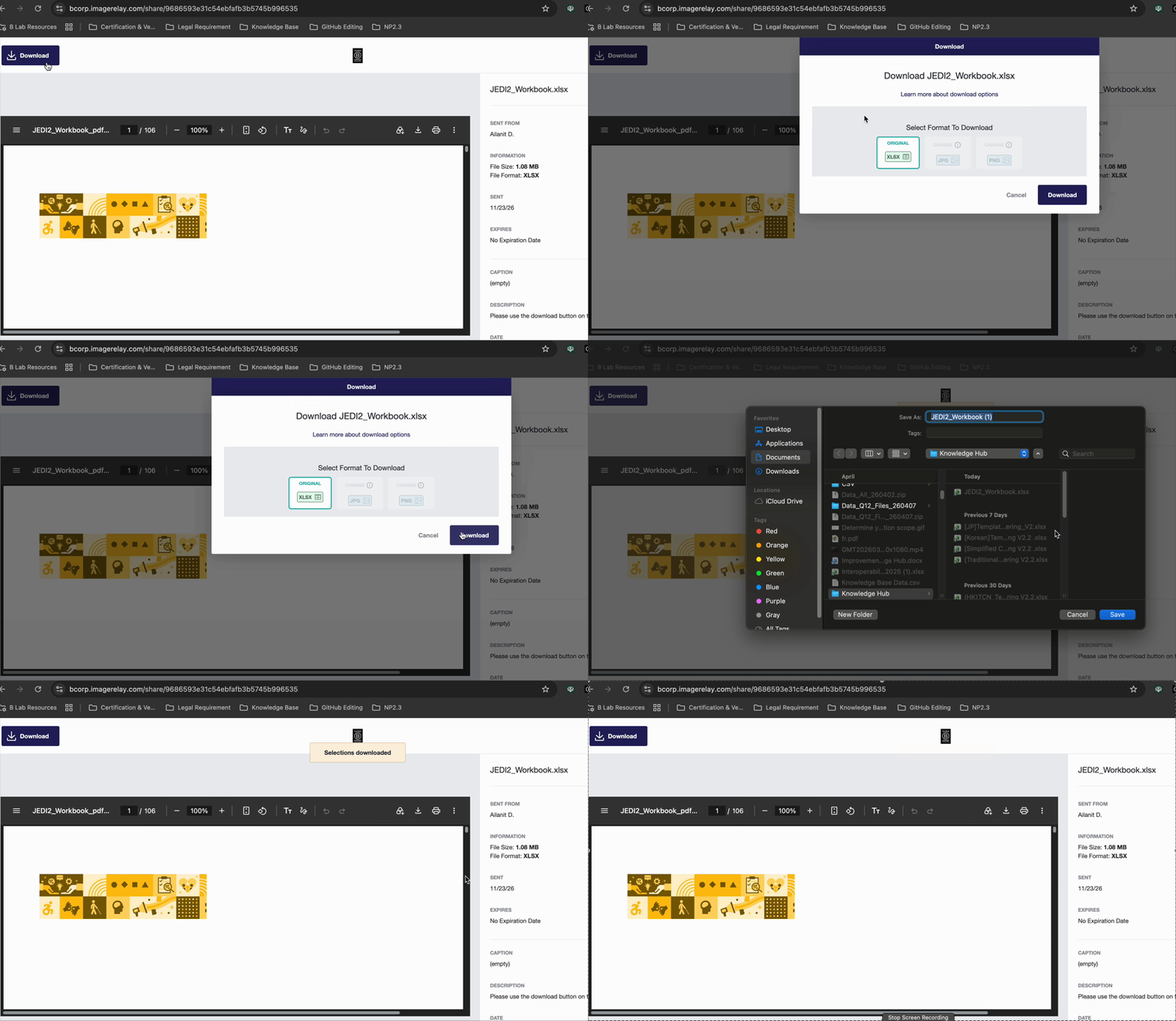
To use the JEDI workbook, first download it as an XLSX file. The workbook contains 24 tabs, each serving a specific purpose. Companies should complete the tabs relevant to their selected JEDI actions and reporting requirements.
Tab 1 – Action Selection Overview: Use this tab to provide an overview of the JEDI actions selected by your company and indicate the year(s) in which each action applies. Reporting is progressive across the audit cycle. Companies undergoing their Year 0 audit are only expected to identify and record the actions undertaken for Year 0. Actions for subsequent years can be developed and added progressively as the company advances through the audit cycle.
Tab 2 – Stakeholder Feedback Log: Use this tab to document the stakeholder feedback and data that informed the selection and prioritization of your JEDI actions.
Tab 3 – Overall Action Plan: Use this tab to document the company's overall JEDI action plan. It provides a consolidated overview of the selected actions, their implementation status, deadlines, financial and non-financial resources allocated, and the roles responsible for implementation. The tab also includes a Plan Update and Sharing Log, where companies should record when the plan was updated, when and with whom it was shared, and how it was communicated.
Tab 4 – Detailed Action Plan Template: This tab provides a general template for documenting an individual JEDI action when a dedicated action-specific template is not suitable.
Tabs 5–23 – JEDI Action-Specific Templates: These tabs provide dedicated templates for each of the 19 JEDI actions presented in the Standards, from JEDI2.a to JEDI2.s. Companies should use the templates corresponding to the actions they have selected for each reporting year.
Action planning and progress tracking across the detailed templates
An important feature of the detailed action plan templates (Tabs 4–23) is that they include dedicated sections to document the implementation process for each action. These sections cover: milestones and tasks, resource breakdown and status update log.
The milestones, tasks and resources documented in the detailed action templates should inform the corresponding information in the Overall Action Plan (Tab 3). This ensures consistency between the detailed implementation records and the company's overall JEDI strategy.
Preparing for the audit
When submitting information for the audit, companies may use the completed JEDI workbook to organize and explain their selected actions, stakeholder input, implementation plans and progress.
The workbook includes dedicated fields to link supporting documentation and indicate relevant reference pages. Companies should ensure that the evidence provided demonstrates not only the existence of an initiative or policy, but also their actual implementation and progress, as applicable.
The JEDI workbook is a supporting tool intended to help companies organize and document their implementation of the JEDI2 requirements. It should always be used alongside the B Lab Standards and the relevant implementation guidance, which remain the authoritative reference for understanding the requirements. The workbook does not replace the Standards, establish additional requirements or confirm that a requirement has been met.
Important Notice: The guidance in this article is not part of B Lab's Standards and should be used for informational purposes only. It does not guarantee a favorable audit outcome. All final audit decisions are made independently by B Lab's Assurance Providers. B Lab assumes no liability for the actions, decisions, or omissions of these independent providers.
Was this article helpful?
That’s Great!
Thank you for your feedback
Sorry! We couldn't be helpful
Thank you for your feedback
Feedback sent
We appreciate your effort and will try to fix the article