- Why is it important to measure this data, and how does it contribute to B Corp Certification?
- Calculating your gender wage gap and identifying actions
- Case Studies
- Which methodology should you use?
- Communicating your results
- Additional resources
Why is it important to measure this data, and how does it contribute to B Corp Certification?
Under the Fair Wages (FW) Impact Topic, gender wage gap work is not just “nice to have” for larger companies; it is built into the new standards:
FW2.4: From Year 0, Large, X Large and XX Large companies must calculate their gender wage gap.
FW2.5: From Year 0, X Large and XX Large companies must publicly share their gender wage gap(s).
FW2.6: From Year 3, Large, X Large and XX Large companies must maintain a closed gap, reduce the gap, or justify why it is not sufficiently closed.
Measuring and acting on your gender wage gap, therefore, directly contributes to meeting FW requirements for larger companies, and more broadly supports your commitments on equity and non‑discrimination included in the Justice, Equity, Diversity & Inclusion (JEDI) Impact Topic.
When you communicate your results transparently and commit to taking action, you:
Demonstrate compliance with FW2.4 - 2.6 where applicable.
Foster worker trust and accountability.
Generate clear evidence you can upload under “FW Impact Topic Documentation and Evidence” (calculations, methodology notes, data, and links to public reporting).
Calculating your gender wage gap and identifying actions
B Lab’s standards recognise three methods of calculating gender wage gaps that you can choose from. Understanding the differences between them helps you identify both structural issues and individual inequities.
Calculating the unadjusted wage gap at the company level
Calculating the unadjusted wage gap at the occupational level
Calculating the adjusted/unexplained wage gap
A note on bias and opportunity
Even if an adjusted analysis shows that differences are “explained”, those explanations can still reflect structural gender inequality:
Career interruptions and part‑time work for caregiving can reduce tenure or promotion speed.
Women may be concentrated in lower‑paid job families or locations.
Some employees may be systematically excluded from the projects that lead to higher pay.
This is why FW also includes separate sub‑requirements, such as FW2.7 on equal pay for work of equal value and a cluster of FW2.1–FW2.3 on pay transparency and wage structures.
Wage‑gap analysis should therefore be combined with qualitative work (worker feedback, JEDI analysis, policy review), rather than treated as a purely technical exercise.
Figure 1: Visual representation showing the two calculation methods. On the left side of the visual, you can see the unadjusted/raw gap analysis. On the right side, you can see the adjusted/unexplained gap analysis.
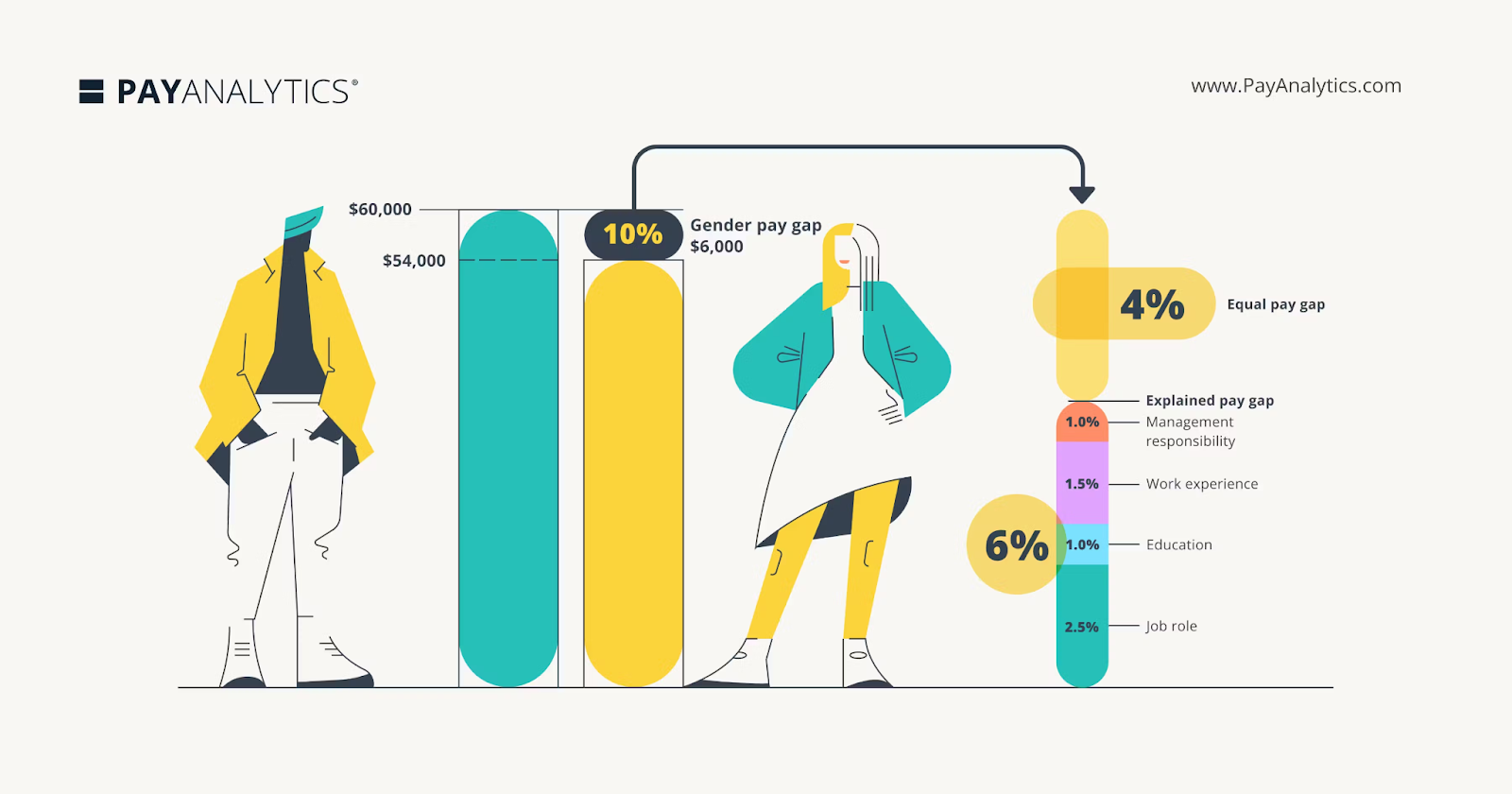
Source: Pay Analytics
Case Studies
Case Study 1: Using the organisation-level unadjusted gender wage gap methodology
Company A: A retail apparel business where women comprise 70% of the overall workforce but are concentrated in front-line store roles. See a breakdown of Company A data below.
Calculating the raw gap (company-level example):
Calculating the % wage gap: In our standards, the unadjusted gender wage gap at the company level is calculated by comparing the average wage of women to the average wage of men across the entire company
You can present it using the ratio format:
Gender wage gap = (Average women’s wage) divided by (Average men’s wage
Example with the Company A’s data (above):
= 180,000 / 240,000 = 0.75 = 25%
Calculating the ZAR difference in wages: To show the absolute difference in pay between men and women, you subtract the average women’s wage from the average men’s wage:
$ difference in wages = (Average men’s wage) minus (Average women’s wage)
Example with the Company A’s data (above):
= 240,000 - 180,000 = 60,000
The Diagnosis:
The large raw gap is driven by occupational segregation, such as:
Women dominate lower‑paid store positions.
Men are overrepresented in higher‑paid HQ positions.
Men are more concentrated in the top pay quartile, while women are more concentrated in the bottom quartiles.
Examples of actions Company A can take to close the gap:
These actions are aligned with FW’s aim to “tackle unfair wages from multiple angles: prevention, awareness, gender wage gap, equal pay for work of equal value, and wages for the lowest paid.”
Case Study 2: Adjusted/unexplained gap methodology
Company B: A large food manufacturer where men occupy 70% of Senior Food Scientist roles. See below breakdown of the company data.
The Results
The analysis from the third party returns the following headline results:
Adjust/”unexplained” gap
After controlling for job family, job level, location, tenure and qualifications, the model finds that women earn 97% of what comparable men earn
This implies a 3% adjusted/unexplained gap
Focus on senior food scientist
Men occupy 70% of senior food scientist roles and earn on average 125 € vs 120€ for women.
When controlling for years of experience and qualifications within the senior food scientist group, a small but persistent unexplained difference remains in favour of men.
Diagnosis:
The 3% adjusted gap indicates that, event after accounting for legitimate factors (role, level, tenure, education, etc.), women are still paid less than comparable men.
According to FW2.6, a gap of 5% or less is considered “closed”, so this falls within the acceptable margin.
However, this “unexplained portion” may still warrant attention, especially in senior specialist roles, to ensure ongoing pay equity and monitor any emerging trends.
Examples of actions Company B can take to close the gap;
Which methodology should you use?
Use the unadjusted gender wage gap at the company level to identify and highlight broad structural representation issues across the whole organisation (for example, whether men are concentrated in higher‑paid roles overall).
Use the unadjusted gender wage gap at the occupational level (by job, occupation level, or category) to identify and highlight structural representation issues within specific job families or levels (for example, where men dominate senior specialist roles).
Use the adjusted (unexplained) gender wage gap methodology to investigate and identify potential individual or within‑role pay equity issues in greater depth, after controlling for legitimate factors such as role, experience, and qualifications.
For large or multinational organizations, adopting a central-to-local model can be a useful and effective approach:
Central team: Leads the analysis to ensure a single source of truth and consistent math across different payroll systems.
Local teams: Manage the follow-up actions based on that data.
This approach is consistent with FW expectations for managing group versus subsidiary‑level actions.
Local reporting requirements: In certain jurisdictions, there are specific legal requirements for gender wage gap reporting. These often dictate specific calculation methodologies and required data points, such as commissions, bonuses, or benefits-in-kind. Ensure you are aware of the applicable local legally mandated reporting requirements and timings in these markets.
Communicating your results
FW 2.5 explicitly requires applicable companies to publicly share their gender wage gap(s), with a link to a public page or report that explains the methodology used.
Internally, communication supports worker understanding and accountability (aligned with FW 2.2’s emphasis on explaining how wages are set). Examples of good practice (not mandated, but FW-aligned) include:
Internal briefings and town halls to explain the difference between raw and adjusted gaps.
Manager toolkits and FAQs to equip leaders and managers with talking points regarding pay bands and review processes.
Personalized Equity Statements with one-to-one conversations with individuals around salary corrections.
Engagement with relevant Employee Resource Groups or worker groups to share data and create a feedback loop, ensuring solutions like mentorship meet real employee needs.
Externally, communication demonstrates transparency, industry leadership, and jurisdictional reporting requirements. Examples of good practice can include:
Your Impact Report to include your FW 2.4/2.5 data and methodology in sustainability or impact reports.
Meet any local reporting obligations, such as the EU pay transparency rules or other national schemes highlighted in the FW Impact Topic Summary.
Action-oriented press release: Publish an action plan connecting your FW 2.6 obligations (closing/reducing/justifying) with your broader wage equity strategy.
Additional resources
Resources to calculate the unadjusted gender wage gap
Resources to calculate the adjusted gender wage gap
Resources to learn about including non-binary people
How To Calculate A Gender Pay Gap (Wgea) See What About Non-Binary Employees? (EN)
Examples of public communications: Natura Pay Equity Report
Important Notice: The guidance in this article is not a part of B Lab's Standards and should be used for informational purposes only. It does not guarantee a favorable audit outcome. All final audit decisions are made independently by B Lab’s Assurance Providers. B Lab assumes no liability for the actions, decisions, or omissions of these independent providers
Was this article helpful?
That’s Great!
Thank you for your feedback
Sorry! We couldn't be helpful
Thank you for your feedback
Feedback sent
We appreciate your effort and will try to fix the article