TABLE OF CONTENTS
- Scope
- Circularity is only one of many environmental considerations
- The waste hierarchy: the starting point for decision-making
- Choosing a circularity option
- What each option requires
- If a single product has multiple circularity attributes
- Demonstrating progress at Year 5
- Companies with multiple products
Designing products with circularity in mind is a key step toward reducing waste and minimising pressure on natural resources. ESC 3.3 of the B Lab Standards requires companies to incorporate circularity principles into their product development. This article explains when the sub-requirement applies, how to choose the right option, and what each option requires in practice.
Scope
This sub-requirement applies to products that the company produces or that have been produced on its behalf. Products the company merely resells may be exempt, relevant for companies in the Wholesale/Retail sector. For companies in the Service with Significant Footprint and Agriculture/Growers sectors, ESC3.3 only applies if the company sells a physical product and has control over its production. If your company is in scope of this sub-requirement but does not meet the conditions outlined above, you can indicate so by following the steps outlined in this article: How to manage sub-requirements with conditions or options.
For fast moving consumer goods (food products, beverages, toiletries, cleaning supplies, medicines, and similar products), this sub-requirement applies to the packaging of those products.
Examples of cases where ESC3.3 applies:
Canvas bags manufactured by the applicant company
Toiletries manufactured by the applicant company
Edible items sold by a restaurant which have restaurant’s logo on them (i.e. which are produced on the restaurant's behalf)
Beverages sold by a retailer which have the retailer’s logo on them (i.e. which are produced on the retailer’s behalf)
Examples of cases where ESC3.3 does not apply:
Products of other companies that a retailer merely resells
Food cooked and served at a restaurant
If legal barriers prevent a company from adopting circularity principles in its product or packaging, the company is only required to meet this sub-requirement to the extent that is legally permissible. In such cases, the company should provide a reference to the relevant legislation alongside an internal explanatory document describing how it applies to their specific context.
A note on packaging types: the sub-requirement distinguishes between three types of packaging:
Primary packaging: materials that physically contain or hold the product, typically in direct contact with it
Secondary packaging: additional packaging included in the sales unit as offered to the end user at the point of purchase — for example, a toothpaste box or an outer box containing individually wrapped units
Tertiary packaging: materials used exclusively for shipping, such as cardboard boxes, pallets, or shrink wrap.
The company is strongly suggested to focus on its primary and secondary packaging. However, context may be considered. For instance, if legislation prevents the company from applying circular design principles to its primary or secondary packaging, it may focus on tertiary packaging instead.
Circularity is only one of many environmental considerations
Circularity principles do not replace other environmental considerations in product development – they are an additional layer. When making product and packaging choices, a company should consider factors such as greenhouse gas emissions, water use, and broader environmental impacts alongside circularity.
For instance, for ESC3.3a, a packaging switch that reduces single-use packaging but significantly increases water consumption or carbon emissions in production or transport may not represent a net improvement. In such cases the company may decide to focus on other options instead. Nevertheless, for ESC3.3a, there are different possible actions that would count as explained below.
The waste hierarchy: the starting point for decision-making
Before selecting a circularity option, companies must be able to explain how their product and packaging design follows the waste hierarchy. The waste hierarchy prioritises avoiding waste entirely over managing it — meaning the company should work from the top down:
Avoid — eliminate unnecessary products or packaging altogether
Reduce — minimise the amount of material used
Reuse — move to reusable formats & ensure products can be used for a long time
Recycle / recover — design for end-of-life recirculation as a last resort
This means, for example, that before considering recyclable packaging, a company should consider whether packaging can be eliminated or made reusable. Recyclability sits lower in the hierarchy.
When considering circular design, as outlined in the Clarifying Compliance Criteria, companies must also examine the recycling infrastructure available in the locations where their products are sold. Where infrastructure is scarce, the focus may shift to durability and material choice rather than recyclability. To support the analysis, under ESC3.4 X Large and XX Large companies are required to do an in-depth recycling infrastructure analysis. For other companies a formal study is not required. Companies of size Large and below may satisfy the infrastructure analysis requirement under ESC3.3 by preparing a short internal note covering, for instance:
the key markets the company has identified,
the sources consulted (for example, national or regional recyclability databases, sector or industry associations, or packaging supplier information), and
the resulting design conclusions.
Choosing a circularity option
Under ESC 3.3.1, companies choose one or more of four options, listed here in order of preference from highest to lowest in the waste hierarchy:
Companies may choose more than one option. The preference is to select options that are as high in the hierarchy as the company's product type and context allow.
There is flexibility in how this sub-requirement is implemented – the company sets the pace. It may focus on improving the circular design of one or more products or packaging items (or their components), while ensuring that the overall product portfolio demonstrates improvement over time. It is also possible that some packaging does not yet fit any of the four options. B Lab acknowledges this possibility and expects the company to work progressively toward meeting at least one option across its portfolio.
What each option requires
ESC 3.3a — Avoiding and reducing single-use products and packaging
This is the highest-priority option. If the company chooses this option it must know the percentage of single-use products (by weight, excluding packaging) and single-use packaging (by weight) in its portfolio, and must record reductions resulting from actions taken, along with the specific actions it took.
A company automatically meets this sub-requirement if it has avoided single-use products and packaging in more than 50% of its portfolio in industries where single-use is the norm.
To count as single-use the company applies the following definition: Products and packaging that are used once, or only for a short period, before being thrown away. Single-use products and packaging can have drastic, global impacts on the environment and human health, and are more likely to end up in the sea than reusable options. Examples include disposable cutlery, plates, straws, drink containers, plastic bags, packets and wrappers, wet wipes, and sanitary items.
Actions to reduce single-use go beyond simple material substitution. They may include, for example:
Reducing product or packaging components — for example, a cosmetics company eliminating the secondary cardboard box around a product that is already in a primary container.
Eliminating packaging entirely — for example, a food company moving to plant-based, edible coatings (instead of using single-use shrink wrap) that extends the shelf life of fresh produce and reduces food waste in retail settings.
Switching to product as a service — for example, a takeout containers manufacturer offering a new product line of containers on a subscription basis rather than selling single-use containers, retaining ownership and responsibility for the packaging component's full lifecycle.
Switching to reusable or refillable packaging — for example, a cleaning product company replacing single-use bottles with refillable pouches or a take-back system, so the same container is reused repeatedly (this would also be captured under ESC3.3b).
ESC 3.3b — Designing for long-term use
The company records the percentage of products and packaging (by weight) designed for durability, repairability, or reusability during use. If a product or packaging meets multiple criteria within this option, it is counted only once.
Durability: The product is designed for maintenance, longevity, and durability in a way that encourages longer use than is typical for that product type, supported by in-house or external testing. For products that are inherently long-lasting, the company may prioritise other principles and explain why.
Example: an outdoor apparel company using reinforced stitching and weather-resistant materials, with wear-testing confirming the product outlasts comparable garments.
Repairability: The product has at least one design feature enabling repair through existing systems operating at scale, or by the user themselves.
Example: an electronics company with modular components, standardised screws, affordable spare parts, and published repair manuals.
Reusability: The product has at least one design feature enabling reuse for its original purpose. For packaging, this means inclusion in a refill system or take-back programme.
Example: a food brand with a concentrated refill pouch to top up a durable branded bottle, or a beverage company with a bottle return and refill scheme.
ESC 3.3c — Designing for recirculation after use
The company records the percentage of products and packaging (by weight) designed for disassembly, remanufacturing, or refurbishment. If a product or packaging meets multiple criteria within this option, it is counted only once.
Disassembly: The product has at least one design feature improving ease of disassembly compared to an alternative, with publicly available instructions that the general public can follow using common tools.
Example: a furniture company using reversible connections with published disassembly instructions, allowing separation by material type.
Example: a beverage company with a detachable label — using a perforation or water-soluble adhesive — enabling clean separation of label and bottle body into distinct material streams. Depending on implementation, this may also qualify under ESC 3.3d.
Remanufacturing: The product has at least one design feature enabling disassembly, extraction of functioning parts, and rebuilding into a new product performing at original specification.
Example: an automotive parts company designing engine components with removable sleeves for extraction, cleaning, and rebuilding.
Refurbishment: The product has at least one design feature enabling it to be returned to good working condition — by replacing faulty components, making cosmetic changes, or updating specifications — without changing its functionality.
Example: a technology company designing laptops with upgradeable RAM and storage, with a trade-in programme for cleaning, updating, and reselling returned devices.
ESC 3.3d — Designing for end-of-life recirculation
This is the lowest-priority option. The company records the percentage of products and packaging designed for recycling or recirculation through the biological cycle*, and must demonstrate that its design exceeds standard practice. The company explains how it defines standard practice and how its design exceeds it. This can be quantitative or qualitative, and may include comparisons with industry peers, third-party data from recycling facilities or research organisations, or Life Cycle Assessment results. The company must demonstrate how it considered the infrastructure available where its products are sold, meaning how its product design is compatible with existing recycling systems.
Recycling: Products and packaging compatible with existing recycling systems currently operating at scale in the markets where they are sold.
Example: a packaging company that designs its bottles using a single polymer type with no mixed materials or labels that interfere with sorting, verified as compatible with recycling streams in its key markets. This exceeds standard practice because most bottles on the market in their industry combine multiple materials, such as a PET bottle with a PVC label and a PP cap, which reduces recyclability.
*Biological cycle: Products and packaging designed for composting or anaerobic digestion.
Example: a food packaging company that switches to certified compostable packaging for single-serve products, verified as compatible with industrial composting infrastructure in the countries where it is sold. This exceeds standard practice because most single-serve food packaging in the sector uses multi-layer laminate materials that are not recoverable through any biological cycle.
Note: Companies that chose ESC 3.3d in their first applicable year must, at Year 5, progress to one of the higher-priority options (ESC 3.3a, 3.3b, or 3.3c).
If a single product has multiple circularity attributes
A single product may have circularity attributes that are eligible for multiple options.
Within a single option: A product is designed for multiple attributes within the same option – for example, a product designed for both durability and repairability under ESC3.3b – is counted only once when calculating the aggregate percentage of products that count under ESC3.3b in your product portfolio.
Across options: A product may be counted under multiple options. For example, a bottle with a detachable label could legitimately be reported under both ESC 3.3c (disassembly) and ESC 3.3d (recycling) if it meets the compliance criteria for both.
Demonstrating progress at Year 5
By Year 5, companies must either:
Increase the percentage of products or packaging under their chosen option, or
Add an option that sits higher in the waste hierarchy, or
Reduce the percentage of products that did not fit into any one of the options
For example, if at Year 3 a company has 40% of its products (by weight) designed for disassembly (counted under ESC3.3c) and the rest of the products do not fit any option, then at Year 5 the company should either:
Increase the percentage of products designed for disassembly to above 40% (e.g. update the products that do not fit under any option by designing them for disassembly)
Allocate some products to ESC3.3a-b, as appropriate (e.g. introduce a new line of products that are designed for reusability, while reducing the products that do not fit under any option)
Reduce the percentage of products that did not fit into any one of the options (in which case they can select ESC3.3d, as well)
Companies with multiple products
If the company has multiple products in its portfolio, ESC 3.3 applies to the entire portfolio. This means:
Evaluating which product or packaging fits under which of the four options
Calculating all required percentage indicators across the full portfolio to establish a baseline
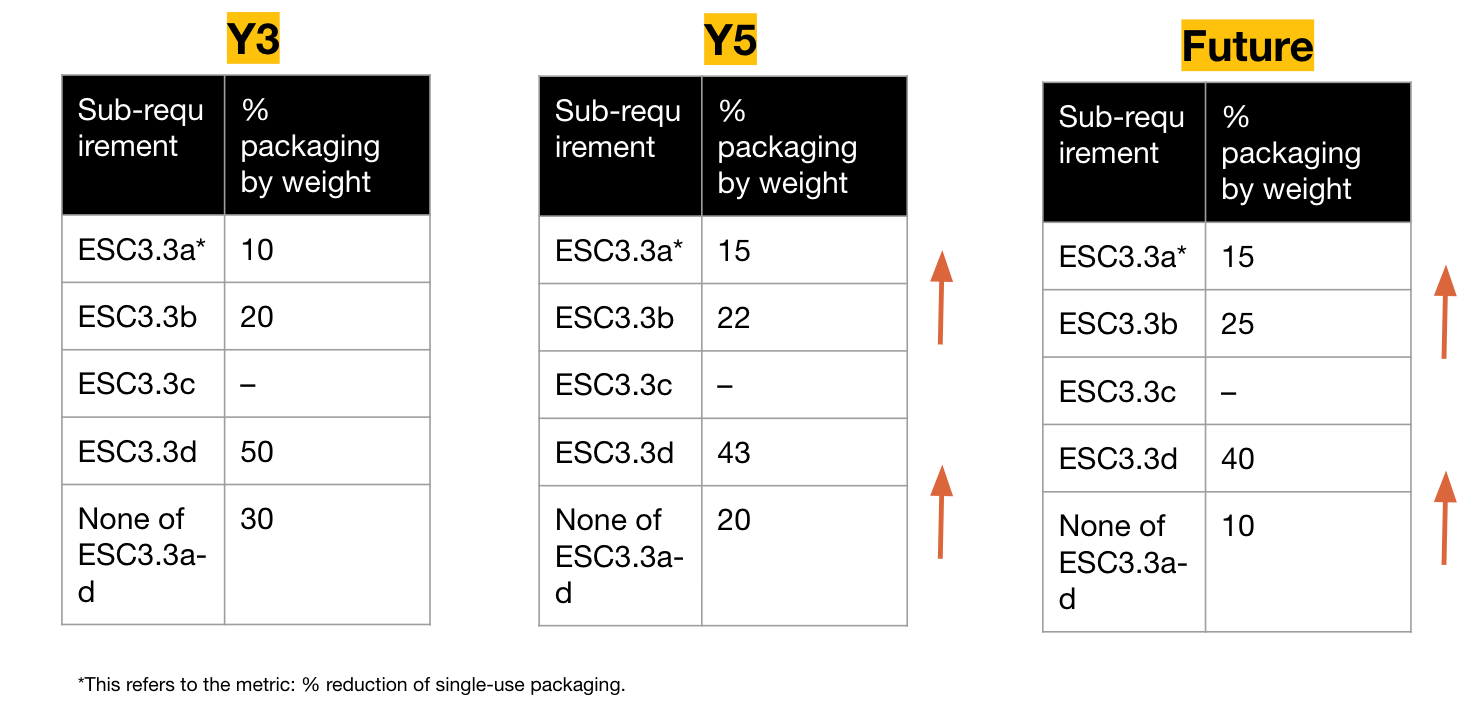
If some products do not yet fit any of the four options, the company provides an overview of the percentage (by weight) of products and packaging that do not currently qualify, and must reduce this percentage by Year 5.
If one or more products do not yet fit any option, the company may reselect ESC 3.3d at Year 5 for those products. Please refer to an illustrative example of how a company with multiple products may demonstrate progress over the years.
Related resources
Was this article helpful?
That’s Great!
Thank you for your feedback
Sorry! We couldn't be helpful
Thank you for your feedback
Feedback sent
We appreciate your effort and will try to fix the article