- Introduction
- Selecting and Engaging Suppliers
- Examples of considering environmental impact in procurement decisions
- Recommended Good Practices
- Additional Resources
Introduction
Suppliers play a critical role in a company’s environmental footprint. From raw material extraction to manufacturing, logistics, and services, many of the most significant environmental impacts occur outside a company’s direct operations.
The B Lab Standards support companies in using procurement as a key lever to:
- Identify environmental risks,
- Integrate environmental considerations into purchasing decisions, and
- Work with suppliers to improve environmental performance over time
This How-To Guide explains how companies can meet sub-requirements 5.1 and 5.2,, using a practical, proportional, and integrated approach that aligns environmental and human rights due diligence.
Actions the company takes to meet sub-requirements HR4.2 and HR4.3 — to consider actual and potential human rights impacts in procurement decisions — may count towards these sub-requirements. This means the company can use a single process to assess both social and environmental impacts. However, to meet this requirement, at least one of the most important procurement decisions must show that the company considered environmental impacts.
Step 1: Identifying Material Procurement Decisions
Sub-requirements ESC5.1 and ESC5.2 focus on how companies identify their material procurement decisions.
The company can determine its “most material” procurement decisions using any of the following categories:
• Spend
• Volume
• Importance of a potential negative environmental impact, which may also include animal welfare.
It is recommended to use multiple categories to determine the “most material” procurement decisions, including the importance of potential negative impacts. If the company chooses to assess the importance of a potential negative environmental impact to determine if a procurement decision is material, then the company needs to consider the likelihood and severity of the impact. Severity should outweigh likelihood, so that highly severe impacts — even if they are unlikely — are still prioritized. For more information on how to evaluate materiality of environmental impacts please see the article ESC 1.7: How to conduct an environmental impact assessment
This requirement applies to all forms of procurement (raw materials, goods, and services).
Companies may use one integrated process to consider both human rights and environmental impacts, provided environmental impacts are clearly documented.
Step 2: Assess if any negative environmental impact may occur
For the most material procurement decisions assess if there is any actual or potential environmental impact. For instance,
- conduct research of specific suppliers, products or materials, or source countries.
- engage your supplier directly for more information.
Step 3: Considering the Impact in Material Procurement Decisions
To meet ESC5.1 and ESC5.2, companies must show how procurement decisions were influenced by environmental considerations.
Actions may include, for example:
- Adjusting What Is Procured
- Procuring locally
- Procuring second-hand
- Selecting renewable materials from sustainable sources
- Using reused or recycled materials
- Avoiding virgin non-renewable materials
- Reducing or eliminating single-use products and packaging
Selecting and Engaging Suppliers
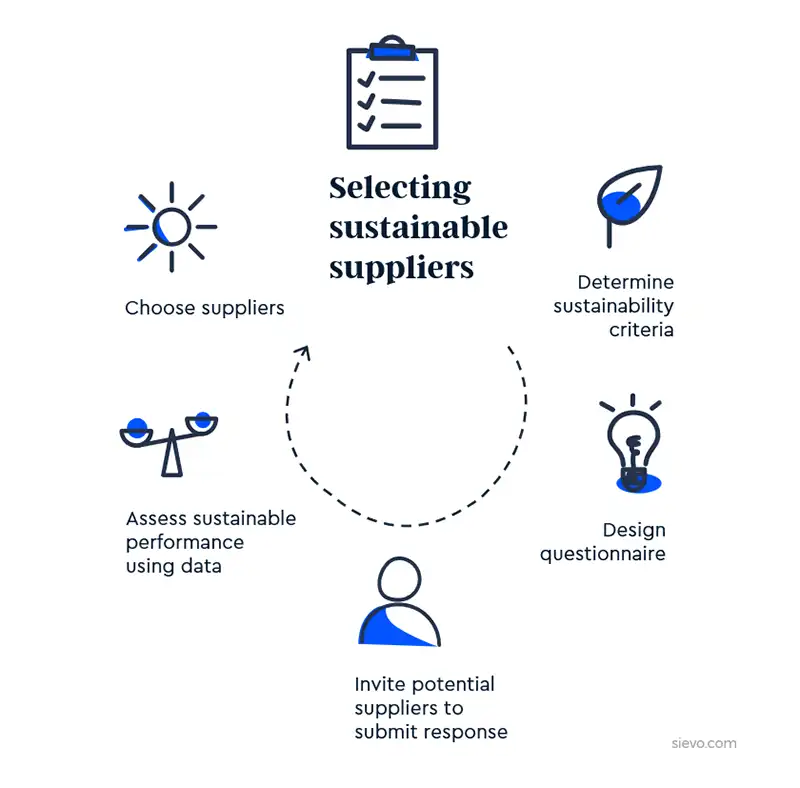
For formal supplier relationships, companies may:
- Engage suppliers to understand how they manage environmental impacts
- Establish a responsible procurement or sustainable sourcing policy
- Incentivize suppliers to improve sustainability performance
- Prioritize environmental criteria during supplier selection
Prefer suppliers that:
- Align with the company’s environmental strategy
- Have environmental policies, targets, or certifications
- Demonstrate strong animal welfare practices
When the company considers the environmental impact of a procurement decision it may realize that it is challenging to take action to mitigate the (potential) negative environmental impact due to, for instance, that the company has no or limited options in terms of the product or service, or the supplier. The company can still demonstrate compliance by explaining how it has evaluated its procurement options.
Examples of considering environmental impact in procurement decisions
Example 1: Raw Materials
A company identifies its procurement of palm oil as highly material due a material environmental impact, deforestation risk.
Actions taken:
- Conducts risk research by country of origin
- Prioritizes third-party certified palm oil
- Switches to a locally sourced alternative, e.g. rapeseed oil, with better visibility on the production practices and environmental management of the supplier
- Enquires origin related information and engages suppliers on traceability improvements, where possible
Example 2: Finished Goods
A consumer goods company identifies plastic packaging procurement as most material as a combination of volume and environmental impact.
Actions taken:
- Re-evaluates if it can reduce or avoid packaging
- Replaces virgin plastic with recycled content
- Prioritizes suppliers aligned with circularity principles
- Updates supplier selection criteria to include environmental performance alongside price and quality
Example 3: Service Sector
A professional services company, that is building a new website, identifies website hosting and data storage as one of its most material procurement decisions based on spend..
Actions taken:
- Includes environmental criteria in supplier selection
- Makes design choices that optimise website for energy efficiency
- Chooses supplier powered by renewable energy
Example 4: Service Sector
A professional service company identifies that the procurement of electronics (laptops, screens) is a material procurement decision.
Actions taken:
- Prioritises suppliers with credible climate commitments, e.g. that publish emissions data and renewable energy commitments
- Chooses suppliers with take-back or refurbishment programmes
- Procures refurbished electronics
Recommended Good Practices
Companies are encouraged to:
Develop a sustainable procurement guideline with environmental criteria
Use the B Lab Standards as a foundation, including:
- Environmental Stewardship & Circularity
- Climate Action
Ensure procurement decisions support circularity by:
- Reducing virgin non-renewable materials
- Enabling reuse and recycling
- Align procurement actions with broader environmental strategy and targets
Additional Resources
Examples of a Sustainable Procurement Policy Template
UNEP Sustainable Public Procurement
Was this article helpful?
That’s Great!
Thank you for your feedback
Sorry! We couldn't be helpful
Thank you for your feedback
Feedback sent
We appreciate your effort and will try to fix the article