- Introduction
- Understanding the fiscal year information
- Understanding the company size
- Company location
- Company sector
- Company Industry
Introduction
Your self-assessment is tailored to the size, sector, industry, and location of your company. This article explains how to complete the Scoping: Customizing your Assessment section in certification setup to generate the most appropriate version of the self-assessment for all entities in your certification scope.
Understanding the fiscal year information
When completing your certification setup in B Impact, you will be asked to provide your company's revenue based on the fiscal year – a 12-month accounting period that is used for financial and tax reporting purposes. In other words, you’ll provide the financial data from the last full year where your accounts were finalized or "closed."
For example, if you are completing your certification setup in June 2026, here is how to select the fiscal year:
Option A: If your 2025 fiscal year accounts are already finalized and closed, use 2025 data.
Option B: If your 2025 accounts are still being audited or drafted, use your finalized 2024 data.
Whatever fiscal year you select, B Lab asks that your fiscal year data be no older than 18 months to ensure that your certification matches your current reality.
Why accuracy matters
Because your Certification Scope summary locks in your track for the next 12 months, double-checking your revenue and entity data during setup can save you significant time later.
If your Certification Scope summary is updated or expires, and your fiscal data passes an 18-month threshold, you will be asked to provide updated data. Keeping your data current ensures you are being evaluated fairly. B Lab will not proactively request you to update your fiscal year data unless your Certification scope summary expires or a significant scope change is reported.
Understanding the company size
B Lab determines your company’s size based on the number of workers as well as your company’s revenue in U.S. dollars (USD) – whichever has a lower value is the default size designation.
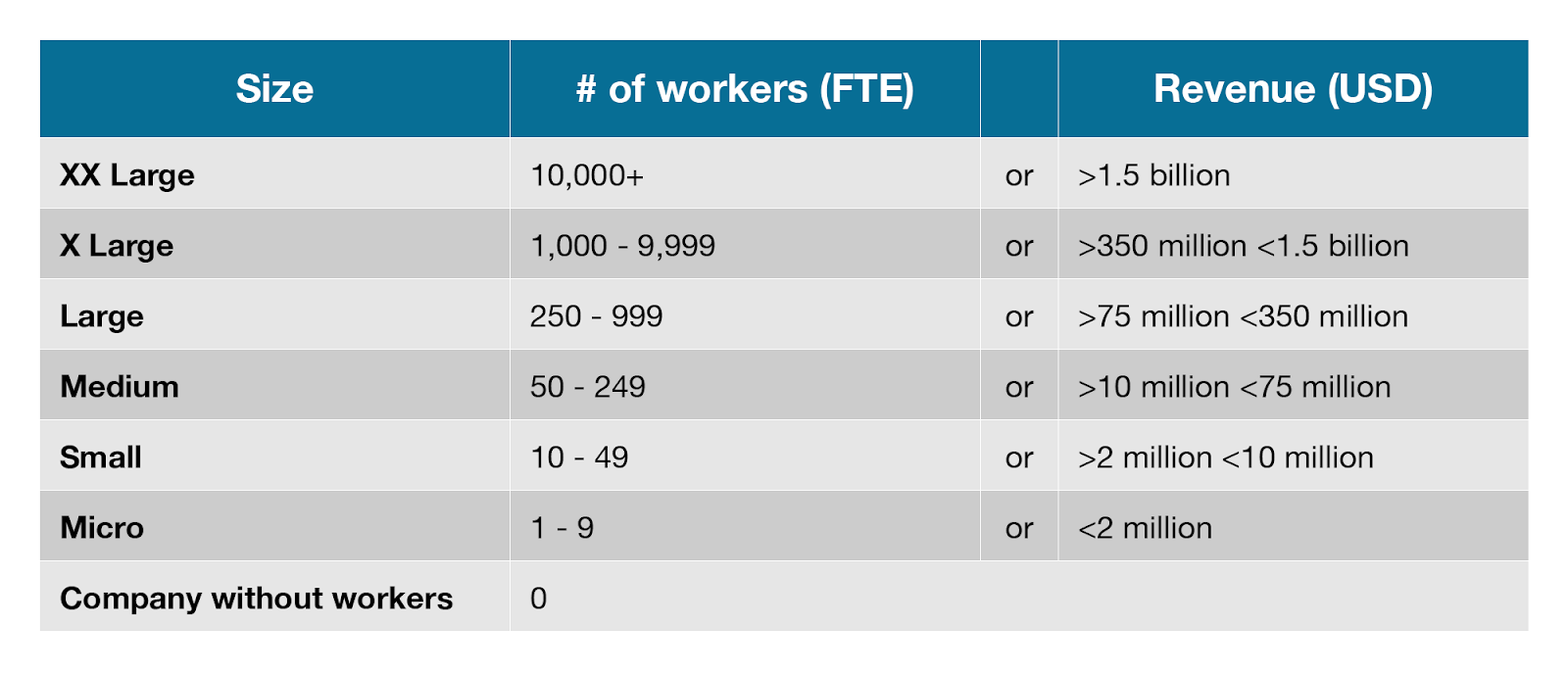
Worker size is determined by Full-Time Equivalency (FTE), a measure of the work done by the company’s entire workforce as if they were all full-time employees. This standardized approach allows for a fair comparison across different types of workers, ensuring equitable consideration for each one.
The B Impact platform automatically calculates your company’s full-time equivalency value based on the numbers reported in each worker category. The calculation is based on the following type of workers, if your company has them:
Some things to consider:
*If your company has individual independent contractors who have been working for longer than 6 months at your company, they will be considered part of the worker count, either as part time (less than 35 hours a week) or full time (35 hours or more a week).
If your company’s workers consist only of founders or partners who own 10%+ of your company, then your company’s worker size should be 0 (or Company without workers). Companies without workers are exempt from the requirements in the Fair Work Impact Topic.
Company location
Your company will not see different requirements in your assessment based on your location. Instead, your location will determine whether your company is eligible for the equity mechanism. The equity mechanism allows some companies to opt out of certain sub-requirements, to account for operational barriers posed by a company's geographical location.
To establish location, simply input your company’s central function location, defined as the entity or site that the company has designated for developing and maintaining their sustainability management system and for ensuring the B Lab Standards requirements are met at all sites within the scope of certification (which may be the headquarters or head office).
Company sector
There are five different sectors that your company can fall under. This is determined through a series of questions in the Scoping: Customize your assessment section. The questions are dynamic and interdependent, which means more questions can show up depending on responses to previous questions. On average, there are six to eight questions in this section.
Your responses to the questions in this section will automatically classify your company into the appropriate sector.
Possible sector outcomes include:
Manufacturing: A company that earns over 10% of its revenue from products it makes, either for direct sale or for sale by another company or brand. Manufacturing involves transforming input materials into a new product. The manufactured product may not be the final product (e.g. food and beverage producers, assembly lines, apparel manufacturers).
Wholesale/Retail: A company that earns over 10% of its revenue from selling physical products, but does not own or operate the manufacturing processes or facilities that produce them. This includes companies that design products but outsource their production. (e.g. grocery stores, consumer goods companies that do not manufacture their own product, wholesalers of physical goods).
Services with Minor Footprint: A company that earns 90% or more of its revenue from services that do not involve selling physical products nor require a physical location for their delivery. (e.g. law firms, marketing & communications agencies, software companies).
Services with Significant Footprint: A company that earns 90% or more of its revenue from services that involve significant machinery or equipment, or require a specific operational location (often key to delivering the service). (e.g. hotels, restaurants, landscaping companies, universities).
Agriculture/Growers: A company that does one of the following:
Earns over 10% of its revenue from products grown on its farm or agro-processing facility, from managing land to grow and harvest crops, or from raising and managing livestock, or
Sources the majority of its raw materials directly from growers or livestock producers (e.g. vegetable farms, coffee plantations or roasters, tree planting companies, livestock farms or ranches). Note: Livestock farms were included in the Manufacturing sector under V1.6 of the B Lab Standards, but now are included under the Agriculture/Growers sector.
Company Industry
Companies in a handful of industries will see a couple of requirements different from the rest. If you think that your sector classification does not match your business, please reach out to our team through the Support Portal.
Was this article helpful?
That’s Great!
Thank you for your feedback
Sorry! We couldn't be helpful
Thank you for your feedback
Feedback sent
We appreciate your effort and will try to fix the article