
The content on this page relates to risk management and mitigation for companies currently undergoing the certification process on V1.6 Standards. To understand how risk is managed in the new B Lab Standards V2, please download the Foundation Requirements here or log in to B Impact.
Under v1.6, B Lab has developed a framework to assess the negative impacts of certifying companies with clients or investments in controversial and ineligible industries, incorporating concepts from internationally recognised frameworks that consider the nature of the involvement of the certifying company with their client’s potentially harmful practices.
The diagram below demonstrates at a high-level how client industry classification, combined with the nature of the certifying company’s involvement, determines different pathways to certification eligibility. Each pathway may require the certifying company to meet additional requirements to ensure accountability, transparency, and, in some cases, take remediation actions—such as reducing revenue derived from harmful industries. All outcomes are subject to final review and approval by B Lab. Continue reading to learn about the industry categorisations and definitions of company involvement.
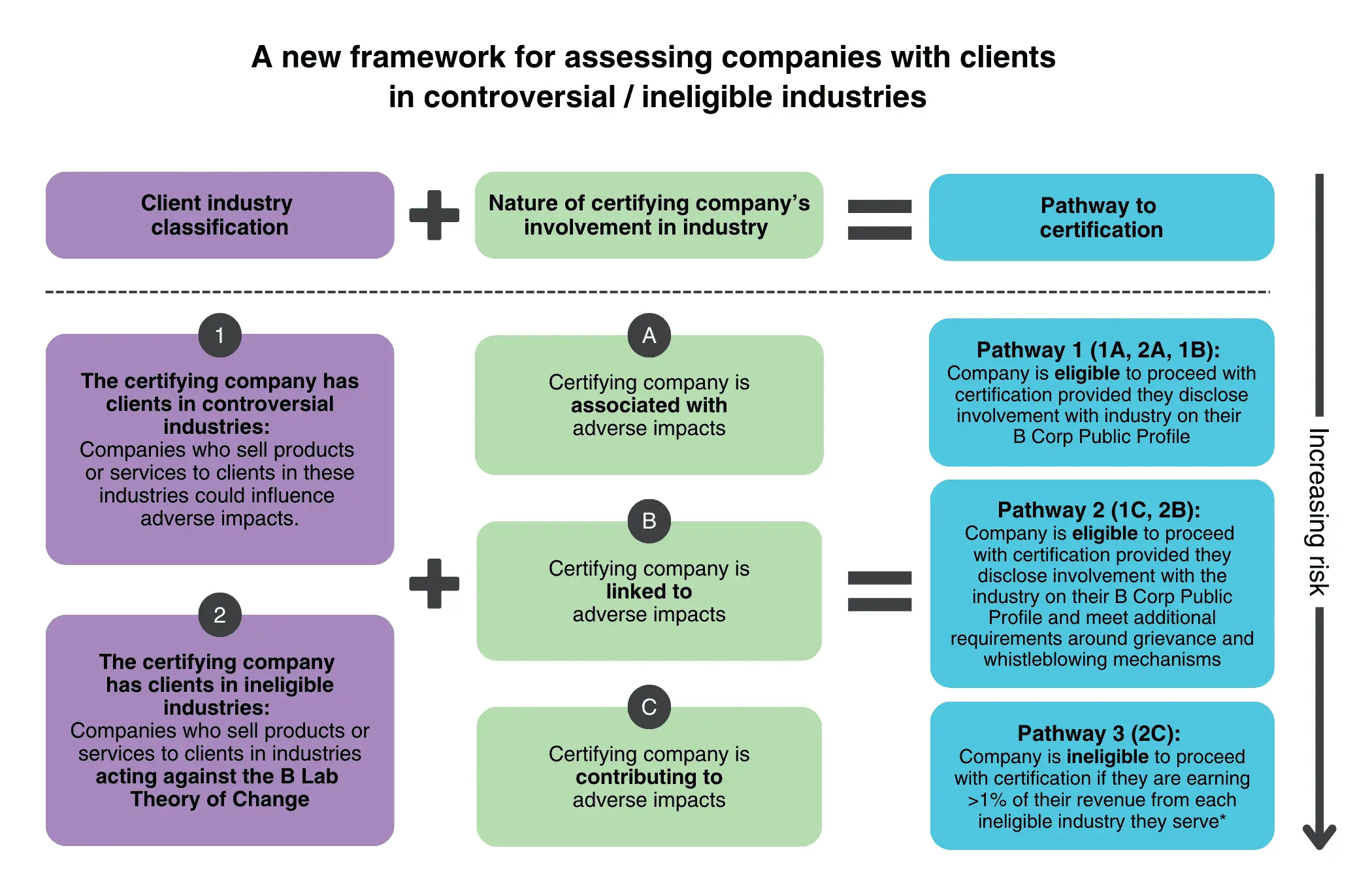
*Companies that submitted their B Impact Assessment on or before 18 Feb 2025, including companies undergoing recertification who initially certified before this date, will be eligible for certification, as long as they meet the same requirements as Pathway 2 during their current assessment. The exception to this is companies in the US and Canada, where a moratorium is applied for involvement with the prison industry. Learn more here.
THE NATURE OF A COMPANY’S INVOLVEMENT
Taking guidance from the framework used by the UN's Guiding Principles on Business and Human Rights, B Lab is using the following levels to categorize the nature of a company’s involvement in a controversial or ineligible industry:
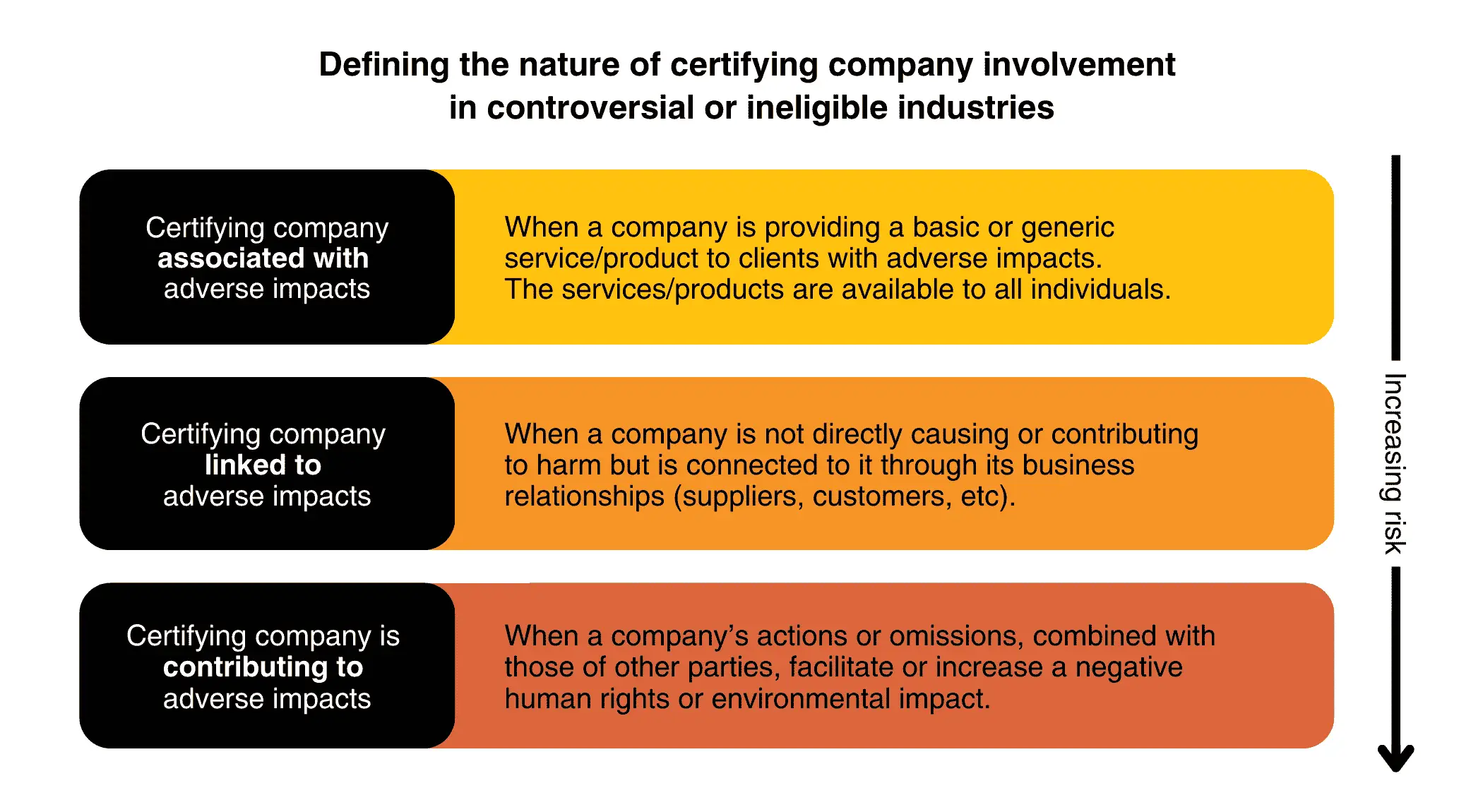
Here are some examples of how a company may be classified under this framework:
Associated:
A toilet paper company selling its products to a tobacco company,
A company installing access ramps in a fossil fuel facility,
Flower shop selling plants to the defense sector.
Linked:
A corporate wellness company hired to provide its services to employees of a pharmaceutical group,
A hiring agency helping a charity lottery to recruit new employees,
Bookkeeping services for a nuclear power plant.
Contributing:
The company sells/rents drilling equipment to fossil fuel companies,
Legal firm representing its mining clients in litigation cases related to their negative social or environmental impacts,
Marketing agency working with gambling clients,
The examples above are non-exhaustive, and the classification is dependent on the interaction between the certifying company and their clients, as the actual and potential impacts of these interactions may vary. For instance, a steel company providing metal beams for the construction of a new office of a Pharmaceutical company will be assessed differently from a company developing steel to be used by gun manufacturers.
INDUSTRY CLASSIFICATION IN MORE DETAIL
Clients in ineligible industries (CII)
Companies that sell products or services to, or invest in, industries acting against B Lab's Theory of Change:
Fossil Fuel and Energy Companies
Gambling
Pornography
Prisons and Detention Centers (including labor)
Tobacco (including all nicotine products)
Weapons and Defense
Clients in controversial industries (CCI)
Companies that sell products or services to, or invest in, clients in these industries may contribute to adverse impacts:
Charity Lotteries
Debt Collection agencies in emerging markets
Nuclear Power or Radioactive Materials
Mining
Pharmaceuticals
Recreational Marijuana
For further information on the industry's scope and definitions, access the Guidance for Eligibility & Minimum Requirements under V1.6.
PATHWAYS TO CERTIFICATION FOR COMPANIES WITH CLIENTS OR INVESTMENTS IN CONTROVERSIAL AND INELIGIBLE INDUSTRIES
The pathways below demonstrate the requirements a company with clients or investments in controversial and ineligible industries must meet to certify, based on the industry categorisation of the client, and the nature of the certifying company’s involvement.
PATHWAY 1: The company is eligible to proceed with B Corp Certification, provided they disclose involvement on their public B Corp profile
Applicable for:
Companies with clients in controversial industries who are linked to adverse impacts OR
Companies with clients in controversial and ineligible industries who are associated with adverse impacts OR
Companies with past clients in ineligible industries in the last 5 years but not serving them anymore
PATHWAY 2: Requiring companies to disclose involvement on their public B Corp profile AND set up grievance/complaints mechanisms, and have a whistleblower protection policy.
Applicable for
companies with clients in ineligible industries that are linked to adverse impacts OR
companies with clients in controversial industries that are contributing to adverse impacts OR
companies with clients in ineligible industries that are contributing to adverse impacts with less than 1% of revenue from each industry
*For further details on meeting this compliance criteria, check the section below “GUIDANCE FOR MEETING THE COMPLIANCE CRITERIA REQUIRED FOR PATHWAY 2”.
PATHWAY 3: Meet Pathway 2 requirements and meet 1% of the total revenue threshold from each ineligible industry.
Applicable for:
Companies with clients in ineligible industries that are contributing to adverse impacts with more than 1% of revenue from each industry
___________________________________________________________________________
GUIDANCE FOR MEETING THE COMPLIANCE CRITERIA REQUIRED FOR PATHWAY 2
The following guidance outlines the components of Grievance Mechanisms and Whistleblower Protection Policies needed to comply with B Lab’s standards:
(1) Grievance/Complaints Mechanism
The Grievance/Complaints Mechanism needs to meet the following requirements to be accepted:
(1.1) The company publishes on its website a grievance form and/or other means for general stakeholders (external) to contact them to raise a grievance in relation to the company and its operations. Please note that the company can have a separate process/mechanism to receive grievances from internal stakeholders.
(1.2) The company provides stakeholders (internal and external) who submit a grievance with information about its grievance process, which includes:
(1.2.1) Grounds for accepting a grievance
(1.2.2) Grievance process steps and targeted deadlines for managing a grievance
(1.2.3) How a resolution will be facilitated
(1.3) The company responds to stakeholders' (internal and external) grievances by either:
(1.3.a) Regularly communicating each step and its outcome in the process for seeking a resolution to the grievance and confirming when a resolution to addressing the grievance has been achieved OR
(1.3.b) Providing a rationale as to why the issue raised was not accepted as a grievance.
Other non-mandatory best practices include:
a whistleblower or ethics hotline
business-to-business contract clauses with dispute resolution provisions
“Open-door” or “speak up” policies for workers
suggestions or feedback boxes, or other worker voice tools
direct stakeholder engagement
worker committees
a customer services department
trade unions and industrial relations processes
consumer complaints mechanisms
Code of Conduct requirements for supplier mechanisms
audit processes, including worker interviews
community outreach and engagement.
Guidance documents that can help the company enhance its practices:
People and planet in business: A simple guide to how small and micro companies can start or strengthen their due diligence (Fairtrade International, B Lab) [EN]
Remediation and Grievance Mechanisms (Business for Human Rights) [EN]
UN Guiding Principles on Business and Human Rights [CHI] [DE] [EN] [ES] [FR] [PL]
(2) Whistleblower Protection Policy
(2.1) The policy outlining whistleblower protection needs to ensure stakeholders’ (internal and external) protection from any form of retaliation for using the Grievance/ Complaints Mechanism. This means implementing measures to enforce confidentiality and assess potential risks to stakeholders.
(2.1.1) The company’s commitment to protecting whistleblowers from retaliation
(2.1.2) Consequences in case retaliation of whistleblowers is identified
(2.1.3) Mechanisms in place to ensure whistleblower protection.
Other non-mandatory best practices include:
Informing those raising grievances about who will need to be involved or informed at the outset
Seeking consent before sharing information with additional parties
Maintaining confidentiality regarding the outcome of the process
Enhanced training for those handling the grievance procedure
Enforcing disciplinary action in cases of confidentiality breaches
Collaborating with independent third parties to assess risks for vulnerable stakeholders.
Guidance documents that can help the company enhance its practices:
The ICC whistleblowing and whistleblower protection policy (International Criminal Court) [EN]
Please note that companies required to meet the compliance requirements must submit, when requested, supporting documentation demonstrating how they meet each requirement. All submissions will be reviewed by B Lab, which will determine whether the company is compliant or needs to take corrective actions to proceed with its certification journey.
Was this article helpful?
That’s Great!
Thank you for your feedback
Sorry! We couldn't be helpful
Thank you for your feedback
Feedback sent
We appreciate your effort and will try to fix the article